Thursday, July 31, 2014

Sister Russia and Our British Cousin. The Trouble with Allies

   "Knowing others is intelligence; knowing yourself is true wisdom"  ~Lao Tzu   


    If you are going to war against a country larger and more powerful than you, you will need allies. At least one, preferably more. In 1914, no one was more aware of this than France. Germany and its satellites were at least 20% larger than France and its population was half again as large. France's primary ally, really its only confirmed ally, was Russia.
  Russia, however, was a constant cause of trepidation to France because it refused to confirm just how much it would thrown in with France when war began. Russia wasn't intending to be malicious with its vacillation, it had its own problems to deal with, and its sheer size and distance from Germany made the way it could wage war different than France.  If Germany started a two-front war, France was immediately in the cross-hairs. It would be the first thing Germany went for.  Russia was so far away that by the time they reached even the borders of Germany, France could have fallen. Russia's distance from Germany allowed it to wait a few days to mobilize. It was also large enough that it could endure a initial (relatively) small loss of territory to the Germans while calling up their reserves.
   Size and distance aside, Russia also had its own problems at home without having to worry about its comparatively small ally. They had just come through a humiliating defeat by Japan in the Russo-Japanese War in 1904-05. That war, considered the "first great war of the 20th Century" was an imperial dispute between Russia and Japan over Manchuria and Korea. After that, Russia had a minor revolution in 1905.If Germany had implemented its Schlieffen plan in 1906, it probably could have wiped out both France and Russia.  But by 1909, Russia was starting to pull itself together again and work out its own mobilization schedules in the event of another war.  Indeed, the mistakes Russia learned from in 1904 helped it to defeat Germany in 1917. After much waffling, Russia surprised everyone by throwing in its lot with France in 1913.      There is still speculation today as to why Russia seemed to have a sudden change of heart. One possibility is that Russia had an Austrian double agent that sold them the secrets of Austria's war plans. Another is that Russia finally got over its defeat by Japan and was militarily and economically to the point where it could start expanding again.  Or perhaps Russia just realized that if France fell, it could not stand alone against the combined force of Germany and Austria-Hungary. Whatever the cause, the idea of having Russia coming at them from behind while they attacked France certainly gave Germany pause.
    Germany was not without its own ally problems. Germany's main ally was its smaller associate to the south Austria-Hungary.  Austria-Hungary vacillated on whether it would or would not help Germany in the next war.  While Austria-Hungary was more interested in taking on Serbia, Germany intended to throw Austria at Poland to keep back the advancing Russian army while they dealt with France. It was not until summer of 1914 that Austria-Hungary finally agreed to engage Russia, and only if Germany guaranteed they would grant them a portion of the German forces to assist.
    Russia aside, the one thing Germany did not consider was Britain getting involved. France couldn't really count on Britain either, because Britain had strongly implied that they did not want to get involved with anyone else's problems.  Britain had an advantage that the rest of Europe did not have, isolation.  They were separated from everyone else by water, while the rest of the countries were separated by a river or mountain range at best, at worst, just a line on a map.  While the rest of Europe had to worry if a conflict elsewhere would spill over into their land, Britain could stay out or choose to get involved, and with whom.  Britannia also had the largest and most powerful navy in the world, although Germany was fast catching up with them. Indeed, if conflict did start, that is how Britain at first planned to engage Germany, by putting its impressive British Navy against the German High Seas Fleet.   Over time, however, the British government and military came to realize that if Germany was the aggressor, the decisive point of battle would lie in France, and it was there they would have to go.  They came to an agreement in 1911, and France added Britain into their battle plans, while Britain went to work determining the fastest way to send soldiers over the Channel. France and Britain had never really gotten along, in the past they went to war against each other as often as not, but this time they would operate on a "the enemy of my enemy is my friend" policy. Stop the enemy from invading you before he invades us both.
     Everyone had been making plans and stockpiling weapons and men for years. Planning moves and counter moves, trying to anticipate the other side's reaction to their advance.  The board was set.  All that was needed now was the opening move.

Saturday, July 12, 2014

Deutschland Uber La Marseillaise: The German-French Hostility

"From the lands where the sun rises to western shores, people are crying and wailing ... the Franks, the Romans, all Christians, are stung with mourning and great worry ... the young and old, glorious nobles, all lament the loss of their Caesar ... the world laments the death of Charles ... O Christ, you who govern the heavenly host, grant a peaceful place to Charles in your kingdom. Alas for miserable me."

Anonymous Monk at the monastery of Bobbio, on the death of Charlemagne

With all this talk about Germany wanting to war with France and France wanting to war with Germany, I really have not clarified why these two neighboring countries wanted to destroy each other so terribly.  Allow me to pause here and explain, at least in part, why they were both spoiling for such a war.  It is not an easy story, for it is a very complicated tale, with many causes and many players. One could spend literally a lifetime studying and writing about the enmity between these two countries. I shall endeavour to put it in a very large nutshell.
    As with most things in Europe, it begins with Rome. Julius Caesar in his On The Gallic War comments on he rivalry and cultural differences between the Gauls, living in what is now France, and the Germanic tribes in present day Germany. The Gauls were a Celtic people who inhabited a territory bounded by the Rhine river on the East, the Atlantic Ocean on the West and North, and the Pyrenees Mountains and Mediterranean Sea to the South. This still corresponds to the borders of modern day France.Once the Gauls were conquered by Julius Caesar, they became thoroughly Roman. Roman citizenship, running water, baths, forums, circuses, speaking Latin and so on. 
   The neighbors across the Rhine were a different story. They were not Celts and they had no interest whatsoever in being Roman. They were the barbarian Germanic tribes. We don't really know what they called themselves, Julius Caesar calls them Germani because that is what the Gauls called them. Rome tried to conquer them too, but after losing three legions to the Germans in the disastrous Battle of the Teutoburg Forest, the Romans pretty much gave up and went home.  In fact, this battle all but ended any further Roman expansion into northern Europe. The hero of this battle was the chieftain of the Cherusci tribe of Germans named Arminius, Armin, or Hermann, depending on what language you are speaking. Remember him and remember Teutoburg Forest, they will be important later. 
   So we have the Roman Gauls and the very un-Roman Germans living on opposite sides of a river. This is why French is considered a "Romance" language while German is not. French has a lot of Latin in it while German has hardly any Latin in it at all, save for a few words. After Rome fell, what is now France and most of Germany was united under the Franks. Though they gave their name to France (i.e. Francia), they were actually a Germanic people who spoke a language that was more German than Latin Gaulish.  Clovis I was the first king of the Franks to unite all the Frankish tribes. He was of the Merovingian Dynasty and is still considered the first king of France. His name, Chlodowig in its original Frankish form,  would later be transformed to Louis in French and Ludwig in German. The Merovingians were later overthrown by the Carolingian Dynasty, founded by Charles Martel, whose grandson would be the most famous Frankish king and one of the most legendary monarchs of all Europe: Charles the Great, Carolus Magnus, Charlemagne.   Charlemagne united all the Franks in Francia and all the German Franks, he conquered south to take northern Italy and west to unite all the territories that would later make up Germany and parts of Austria and Hungary.  Being a Christian, he went to war with the Muslims in Spain and put Pope Leo III under his protection after the Romans tried to put out Leo's eyes and tear out his tongue.  On Christmas Day A.D. 800, Pope Leo III crowned Charlemagne Emperator Romanorum "Emperor of the Romans", declaring the Frankish king the rightful heir to Old Rome. This was a slap in the face to the Byzantine Emperors in Constantinople, who considered themselves the continuation of the Roman Empire.  
   The crowning of Charlemagne founded the Holy Roman Empire, whose ever-changing borders over time would contain all of Germany, most of Austria and Hungary, northern Italy, all of Switzerland, Belgium, and the Netherlands, and parts of Poland and France. When Charlemagne died, he was succeeded by his son Louis who only kept the empire intact in his lifetime. Upon Louis' death, two of his sons divided the kingdom between them into two territories that became later the countries of France and Germany. 
  So, after some nice Christian and Roman unity, it's time to start hating each other again. France, throughout the middle ages into the modern era sought to maintain the borders it had since it was Gaulish Rome as described above, but France was the main nation that went on Crusades, fought wars against the Spanish and the British and owned England itself for a time. France was sophisticated and outward looking. Germany sort of kept to itself and ignored everyone. (Beware the loners, they're usually not quiet so much as plotting.) Also, France was united into a single country.  Germany, or the Holy Roman Empire as it was known, was a collection of smaller territories ruled by lesser kings under a greater emperor. It stayed this way until the early 19th century when Germans started thinking about unification. They were finally driven to unify in 1870 with the Franco-Prussian war. The Franco-Prussian War starts with Napoleon. 
     The Napoleonic Wars are well known enough that they do not need to be discussed here. Let's just say that the German States were very angry with France for the way it had run over them on its way to Russia and Poland. To prevent such a thing happening again, Prussia, the largest and most powerful of the German states, began uniting the norther German territories. This suddenly upset the balance of power in Europe, and Napoleon III, Emperor of France, demanded compensations in Belguim and the left bank of the Rhine, including two little territories largely full of German-speakers known as Alsace-Lorraine. Otto von Bismark, the Prussian Chancellor refused, and turned around started to unify the southern German states with the new northern state, creating modern Germany.  This is where Arminius and Teutoburg come back in. After the Napoleonic Wars, Germans began writing plays and songs about Arminius and his defeat of the French Romans. This even was looked back to as a key point of German identity. 
   France did not want Germany to unify because it would make a country larger and more powerful than itself. France attacked Germany and newly unified Germany responded. They responded by marching all the way to Paris and laying siege to it, intending to starve the French into submission. Finally, an armistice was signed in 1871, less than a year after the war started. Flush with victory, Germany demanded Alsace-Lorraine from France and built a monument to Arminius in Teutoburg Forest, with his statue glowering toward France. 
  So on top of everything that had gone before, the final bone of contention between these two countries was this. France felt threatened by unified Germany, newly unified Germany wanted to start taking back some of the territory it had as the Holy Roman Empire (and didn't want France attacking it again) and France wanted Alsace and Lorraine back. They couldn't wait to start going at each other again. In August 1914 they were only to glad to start going at each other again. 

Saturday, July 5, 2014

The Great Game

"All warfare is based on deception. Hence, when we are able to attack, we must seem unable; when using our forces, we must appear inactive; when we are near, we must make the enemy believe we are far away; When far away, we must make him believe we are near."
Sun Tzu, The Art of War


    Aside from making war, there is another occupation that armies have which is no less important, making plans. Without plans, there is no way to win a war. Alexander the Great planned how to invade Persia, Hannibal planned how to cross the Alps (with his notorious elephants and boulder dissolving vinegar) to take over Rome. Philip II of Spain planned to sail the Spanish Armada to England in 1588, only to have to tables turned on him. Napoleon made war plans almost every year of his conquering career. The North planned how to defeat the South in the American Civil War and so on.
    All of these plans, indeed pretty much any war plans since men began the art of war, were made "on the hoof" when war was either impending or already ongoing. That would change by 1870, with the advent of the new European railway systems which made it possible for armies to move thousands of men long distances ten times faster than they could travel by foot. The railroads also made it easier to supply armies, since food and other goods could be shipped to troops by rail, rather than having to rely on what could be begged, borrowed, bought, or stolen from the surrounding countryside.  The trouble with railroads is, they have to be efficiently timed or nothing will ever go anywhere.  The French army learned this the hard way during the Franco-Prussian war, when empty train cars left sitting on the track blocked the arrival of full trains for miles. Because of this, armies became fixated on ensuring that trains were kept to a strict timetable in war as well as peacetime. The best place to do this was staff colleges.
   Staff colleges were an invention of the latter Nineteenth Century. As mentioned before, soldier-making had become an industrial staple of most European countries, and since armies and navies need officers, staff colleges were set up to train privileged young men to be such. The first staff college was, not surprisingly, founded  by the Germans the same day the University of Berlin was founded. At first, the attendants of these schools were trained to be minions, but later on they were taught to think like generals, play war games, study military tactics, and write solutions to strategic problems. Germany was the founder of the staff college/war college and its models were soon coped throughout Europe. Their tactics were copied and their manuals translated into English, French, and other languages. The best graduates were appointed to general staffs and set to arranging mobilization schedules, writing wartime railway timetables, and finding solutions to every possible outcome of a situation.  Nineteenth century warfare had been turned from something done on an as-needed basis to an intricate art, a trade craft.  An obsessive, giant chess game with the map of Europe as the playing board.  The opening move was designated Mobilization Day ( M-Tag as it was known by the Germans) and everything following was a rigorous schedule of what soldiers and supplies should be placed where and when however many days after M-Tag until they reached the battlefield and the war was won.


The Schlieffen Plan

   As in chess, there are always strategies, and this new art of war was no exception. Generals and their staffs would write out various plans of deployment based on the situation and how they expected their opponents to respond.  These deployment plans, once complete, were pigeon-holed to be pulled out later as needed. The most famous of these is still known even to casual students of history, the Schlieffen Plan.
The Schlieffen Plan was named for its author, Field Marshall Alfred von Schlieffen, and was in short, a plan of how Germany was to crush France once one of them declared war on the other. The Plan was this, nearly the whole German army in a line, hinged at the Swiss border and stretching nearly to the North Sea, would march forward in a large arc across Belguim, Brussles, and finally across Flanders to the French border. The were scheduled to reach the French border by 21 days after M-tag. On the 31st day after M-tag, the German line would run along the Somme and Meuse rivers and the right wing would turn south, enveloping Paris in a pincer-like movement,  driving the French army toward the left wing that was advancing from Alsace-Lorraine. Thus in a gigantic claw, 400 miles in circumference and 200 miles wide, France would essentially be decapitated as her army was crushed.
   This plan would continually be plagued by problems, how long would it take supplies to get to the front, how hard would resistance through Belgium be, and so on. Schlieffen would continue to tinker with his plan obsessively until he died in 1912. His colleagues and successors would also continue to tinker with it. He and the other Germans were unaware that the French had a very similar plan in their war plan index. Known as Plans XIV-XVI, they were all variations on the same theme, to send all of the French forces along the French frontier to block Germany from entering France. It was a mirror of Schleiffen's masterwork, and plagued by the same problems; troop movements, supplies, ect.  If both of these plans had been implemented as written, there would have been gridlock in Belgium and Alsace-Lorraine that may just still be going on today. Fortunately these two armies mobilized in slightly modified versions of their dress rehearsals.
   France had a smaller population and therefore a smaller army than Germany, but remedied this in part by the Conscription Law of 1905, which imposed two years of military service for all young Frenchmen. Germany responded in kind in 1911 with a three year law for all young German men. Thus the world ran back and forth for thirty odd years, laws were changed, battle plans were written, rewritten, and indexed up until zero hour. This is what the staff colleges of Europe did during peace time. It is really no surprise that everyone wanted to go to war so desperately, the were all probably bored. One can only play the world's biggest chess game for so long.
   Oddly enough, there were no diplomatic equivalents of military staff colleges. They cataloged ways to make war, but not ways to make peace. Oxford University had established its professorship of Modern History in the eighteenth century to educate future diplomats, but up to 1914, the British Foreign Office was still choosing its entrants from honorary attaches; that is, young men whose fathers were friends of ambassadors. ("It's not what you know, it's who you know" is at least two hundred years old. It is not a new thing.) Diplomacy was therefore, mostly taught in embassies. European diplomats ante-Great War were a truly international class, they all knew each other as acquaintances or friends and all spoke French as a common language. And they all shared the belief that it was their main job was to avoid war.
    They had done so in the past.  At times when it looked like Europe was on the verge of war they all had enough confidence in each others abilities, a common standard of conduct, and desired above all else to prevent conflict. It was not the fault of the diplomats in 1914 that war finally consumed the world, why did they fail? I am not quite sure of that answer, I am still determining the threads of action and consequence.  The nearest I have come to so far, is that the conscripted young men, the professional soldiers, and the professional officers of the staff colleges were so well taught and well trained that they shouted down the diplomats. And the diplomats, whose very un-industrial trade was neglected, were at last out of their depth.


Saturday, June 28, 2014

June 28, 1914: Wars and Rumours of Wars

"And ye shall hear of wars and rumours of wars: see that ye not be troubled: for all these things must come to pass, but the end is not yet. For nation shall rise against nation, and kingdom against kingdom: and there shall be famines, and pestilences, and earthquakes, in divers places. All these are the beginning of sorrows"
Matthew 24:6-8


Archduke Franz Ferdinand 


 One hundred years ago today, the world ended.

All right not technically, I am still sitting at my desk typing and the sun is still shining in the window so the ball we live on called Earth still exists. But a way of life, of ideals, a set of ethics and morality ended today, Western Civilization began its slow end. An man was murdered, which set off a chain reaction that would result in a war that changed the world forever.    A plot device of  books, movies, and television today is the apocalypse and the post apocalyptic world. I would posit that an apocalypse has come already. I said an apocalypse, not the Apocalypse. The Apocalypse really will end everything, and will come when Human History has reached its end, and God comes to remake the world. The Great War was however, an apocalypse, as we are still reeling in its effects one hundred years later.

   In June of 1914, Austria-Hungary was the weakest of the European powers, and was very sensitive because of this. It's southern neighbor, Serbia, was a backward, aggressive and rather violent Christian kingdom that had just recently won its independence from the Muslim Ottoman Turks. But not all Serbians were Serbs, a good many of them were Austrians, by historical accident. The Serbian Serbs did not appreciate this large minority of Hapsburg Austrians and their big brother to the north, Austria itself. Many among them were, in fact, prepared to kill to get these Austrians out.

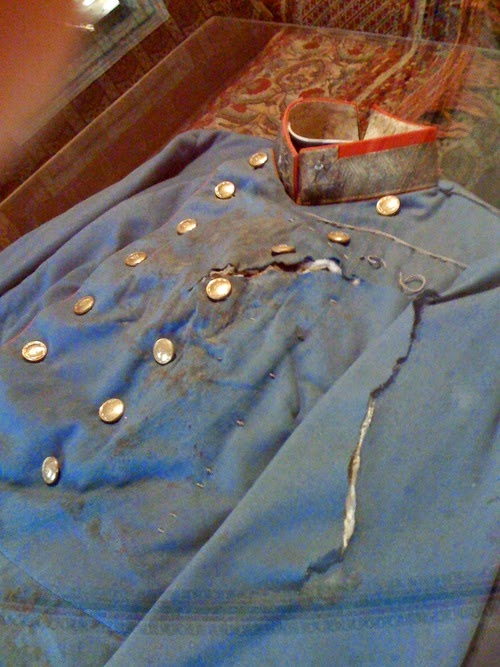
 Austria and its ever changing collection of satellite nations had been ruled by the Hapsburg Dynasty ever since 1279.    The Hapsburg Army's summer maneuvers in 1914 were held in Bosnia, a former Muslim province of Serbia that had been occupied by Austria in 1878 and annexed in 1908 . Archduke Franz Ferdinand was the nephew of the emperor, the heir apparent, and the Inspector General of the army. He arrived in Bosnia on June 25, 1914 to supervise and once the maneuvers were over, he and his wife drove to the capital, Sarajevo, for some official engagements. The Archduke really could not have chosen a worse time to visit Bosnia. June 28th, the next day, was the anniversary of the defeat of Serbia by the Turks in 1389. To the Bosniaks, it must have been like they had thrown off one oppressor only to gain another. His Excellency was warned that his visit was not welcome and could be dangerous, but he proceeded anyway. A murder team lay in wait for him, consisting of five young Serbs and a Bosnian Muslim. On the way to the governor's residence, one of the conspirators threw a bomb at the Archduke's car. It bounced off and exploded under the car, injuring another occupant. Forty-five minutes later, the Archduke and his wife were on the way to the hospital to visit the casualty of the previous attack when the chauffeur took a wrong turn and came to a stop while turning the car around.  This brought them in range of another conspirator who stepped forward and fired a pistol at them. The Archduke's wife Sophie (a woman he had all but given up the throne to marry, out of love) died instantly, the Archduke himself expired ten minutes later. The assasin, Gavrilo Princip, was arrested on the spot.

  The dying words of Franz Ferdinand were "Sophie, Sophie,don't die! Stay alive for our children. Sophie was an impoverished Czech aristocrat, considered unworthy of her husband by the rest of the powerful Hapsburg family. Archduke Ferdinand knew that his beloved wife would not be allowed burial in the Hapsburg crypt in Vienna, therefore, according to his earlier directions, he was buried beside Sophie at Arsetten Castle in Austria.

This assassination started a chain of events that would result in a shocking war that surprised everyone, but everyone wanted at the same time. I will cover the events of that fateful summer in the days to come. Today is to remember the man and his wife whose deaths ended the world.


Archduke Franz Ferdinand's Uniform
  

Thursday, May 29, 2014

The White Warfare

"To
My Comrades
Who fell in the White Warfare 
Of the South and on the
Red fields of France
and Flanders"
Sir Ernest Shackleton, C.V.O


    While Western Civilization was facing the beginning of the end in the summer of 1914, another noteworthy event was also well on its way. Sir Ernest Shackleton, that seasoned Arctic explorer was, with fifty-six other men, about to head south to be the first people to cross the Antarctic Continent. 
    The turn of the 20th century was the Heroic Age, when man's drive to explore every inch of his world peaked, and men sought that last, almost forbidden frontier, the poles. Literally, the very ends of the earth. Many countries were involved in the race to see who would be the first to reach the north and south poles, much like America and the Soviet Union racing for the moon some 60 years later. America won the race to the North Pole in 1909, Britain, an empire in decline, lost the race South to Norway in 1911. 
   Shackleton, a qualified master mariner,  had an abiding love for the cold, extreme edges of our world and was a veteran of polar exploration. He had been a part of Robert Falcon Scott's 1901 to 1903 Antarctic expedition. From 1907 to 1909 he led his own expedition to reach the South Pole, known as the Nimrod Expedition.  Their ship , the Nimrod, made it to within 97 miles of the pole when it got stuck in pack ice and had to turn back.  At that time, it was the furthest south anyone had been and Shackleton was knighted for his efforts. 
   Having lost the race to the Norwegians, Shackleton then devised the last great explorer's quest, to traverse the continent of Antarctica in its entire. Charting, exploring, and crossing the whole continent on foot was indeed nothing anyone had ever tried before. Years in planning the expedition was to be in two parts. One part, in the ship Endurance was to disembark at the Weddell Sea* and head for the pole, taking magnetic and meteorological observations, geological survey, and samples of Antarctic flora and fauna. The other part was to bring another ship, the Aurora,  to the Ross Sea, on the opposite side of Antarctica.  Their party was to go about halfway to the pole from their side and wait for the Endurance party  to meet them, also taking scientific observations. 
  The Endurance set sail August 1, 1914, but she almost never left at all. Once she was fitted out and ready to go, she was to be inspected by His Majesty King George V on the Monday of Cowes Week before setting sail. Cowes week was and still is the conclusion of the Season.  Let me pause and explain the Season. The Season is the social calendar of the elite in England and was also for a time in America. It began in the 17th and 18th centuries and was at its peak in the 19th.  At this time the aristocrats and landed gentry would leave their country houses and come to London to socialize and engage in politics, as it coincided with the seating of Parliament every year. This was also when young ladies were presented to society (and often to the Royal Court) and expected to find a husband as soon as possible. Once the Season was over, everyone would return to their country houses at the beginning of hunting season to shoot birds in Autumn and hunt foxes in Winter. 
   When Jane Austen was writing about Mr. Fitzwiliam Darcy and Miss Marianne Dashwood, the season ran from sometime after Christmas until the end of June. By the late  Victorian Era, the Season was standardized as running from April to August. After the end of the Great War, the Season fell into decline because many great families had to give up their London mansions. The Season is still preserved to this day, but the venues such as the Proms, the Chelsea Flower Show, Wimbledon, and so on are now more public venues. However, most events have a dress code where men and women are often required to dress in a more traditional way that resembles their Edwardian predecessors. It is a desiccated mummy, a last relic of a time gone by. 
Where was I? Ah yes Cowes Week. Cowes week is one of the largest sailboat races in the world, takes place the first week of August, and is one of the last events of the Season.  Cowes week in 1914 was the last real Season before the world blew apart. The Friday before that Monday Shackleton received a message saying the King would not be able to go to Cowes. The date was July 31, Archduke Ferdinand had been assassinated a month prior, and Austria was at war with Serbia.  Germany was threatening to attack France,  and Britain had just warned Germany that if they declared war on France, Britain would declare war on Germany. This last summer, this last Season before the world was turned on its head, was about to see off the last explorers of their kind. 
      Endurance left London Saturday August 1, but stayed anchored off the coast through Sunday, anticipating to be called up for war. Shackleton sent a telegram to the Admiralty offering to cancel his expedition and put himself and his men at the service of the crown. The Admiralty replied simply "Proceed."  Two hours later, Mr. Winston Churchill sent a longer telegram to Shackleton, thanking him and his party for their offer and stating the authorities desired the expedition to continue as planned. Tuesday, August 4th, the King did arrive and gave Shackleton the Union Jack to carry on the expedition. War finally erupted at midnight on that same day. 
    Shackleton took a lot of criticism later on for leaving when he did, without consulting the donors of the expedition. But the Admiralty had told him to continue as planned, and no one expected the war to last more than a few months. Indeed most expected it to be over by Christmas. This tiny capsule of the preserved Edwardian world was about to leave the civilized world to its own un-civilizing, and undergo a conflict against the elements of nature that was no less dangerous or strenuous than men shooting bullets and driving tanks at each other back home. They made it to Buenos Aires, Argentina on October 26, and from there sailed to South Georgia, a small island south of the Falklands which was the southernmost outpost of the British Empire, and indeed the very edge of civilization itself. From there was the unknown. 


* The land and sea area from the Falkland Islands extending to the South Pole was considered British territory at this time. 

Monday, May 19, 2014

Technology Can Save (or Destroy) The World

"War on an industrial scale is inevitable. They'll do it themselves in a few years."
~Prof. James Moriarty Sherlock Holmes: A Game of Shadows

   As I said last time, while the royal cousins of Europe were smiling at each other, back home they were building up their armies and experimenting with new weapons. Symbolic relationships and family ties were not hard currency when it came to foreign affairs.  Since the fall of Rome, international policy had chiefly consisted of national security, that is, military superiority.  Do unto others first,  before they invade you, or if they do try to invade you, make sure you can make them sorry they tried. Exhibit A, the British defeat of the Spanish Armada in 1588.
     For all the new societal organizations and business partnerships, nineteenth century Europe had no solid system of diplomatic mediation. The closest to such that existed was the first Geneva Convention, convened in 1864, and was more about humanitarianism in war than international negotiation. Tsar Nicholas II convened the Hague Conference in 1899, which brought the powers of Europe together to limit the buildup of armaments and also found an international court to settle disputes between nations. The International Court was indeed founded, but the problem was convening the court was to be voluntary.  There is no purpose in having a way to settle international disputes if participation is voluntary.  Any country can then do whatever they please to their neighbors and then politely decline to participate in the court if summoned.
    Britain and France ruled much of the world at this time, thus much international conflict arose over jealous competition between the two of them, and Germany, who had a few colonies that it wanted to keep from the rest. Germany was the worst at provoking the rivalry between these three when, in 1900, it determined to build a naval fleet capable of engaging the Royal Navy. By 1906, the race to out-build Germany was at the forefront of British public policy.  France, in turn, decided to match Germany in number of soldiers. No mean feat, because Germany had a population of 60 million souls, France only 40 million. They did this by enacting the "Three Year Law" in 1913, extending the service of conscripts to three years.
    Thus soldier making and armaments manufacture became yet another of the new industries of the turn of the 20th century.  Nearly all of Europe made it necessary for all their young men to go through military training and remain in reserve until late middle-age.  The exception to this was Britain which, surrounded by sea and defended by the most powerful navy in the world, saw no need for this. Therefore, in 1914 there were some two hundred military divisions ready at a moment's notice, with sufficient firepower to destroy each other in the first few minutes of the war.
      The only thing that kept the world from ending so quickly was communication.  Large armies can only be efficiently deployed with near instantaneous communication, and the world did not quite have that yet. Radio (wireless telegraphy as it was known then) was still in its infancy, and while well known in theory, was not practical in the field. Primitive radios were too large and used too much energy to be used anywhere outside ships.  The telephone and telegraph were the fastest way to send word, and those both depend on fragile wires, easily broken as soon as they were set up. When those failed, the fastest way to send and receive news and commands were the most ancient ways, word of mouth and the written word, which can only travel as fast as a man, or whatever he rides or drives. This is why it first took a while for the war to actually start when war was declared and also why front lines often came to a grinding halt as territory was won and lost by inches later on. Commanders were reduced to confusion and uncertainty, while soldiers waited days or weeks to receive orders.
    Certainly,  it is also this uncertainty in communications that brought the war into being. In that fateful summer, the diplomatic crisis that was ignited by an assassination was slave to the wheel, the written note, the telegraph schedule and the encipher routine. Events swelled and outpaced the ability of diplomats and statesmen to control them, and they overwhelmed the primitive ways of communication. Why no one bothered to use a telephone I cannot say, except that no one thought about it. Telephones were certainly available for use, they had been around for nearly thirty years at least.  Everyone was too used to the regular routine that had served for years. So, the chain reaction began, as if everyone had been wanting to do this for so long, and they felt the had no other choice.

Friday, May 9, 2014

The Interdependence of Nations

Summer surprised us, coming over the Starnbergersee
With a shower of rain; we stopped in the colonnade,
And went on in sunlight, into the Hofgarten,
And drank coffee, and talked for an hour.
Bin gar keine Russin, stamm' aus Litauen, echt deutsch. *
and when we were children, staying at the archduke's,
My cousin's, he took me out on a sled,
And I was frightened. He said, Marie,
Marie, hold on tight. And down we went.
In the mountains, there you feel free.
I read, much of the night, and go south in the winter.

~T.S. Eliot, The Wasteland


   Part of why the Great War came as such a surprise to everyone was because European Culture at the time was so cohesive and united.  Everything was so dependent on everything else that war seemed nearly impossible. In 1910, economic interdependence in Europe caused Norman Angell in The Great Illusion to say that the threat of disruption of international credit would either prevent a war entirely, or bring it to a quick end if war did break out. Almost all informed opinion agreed with this.
     The last two decades of the 19th century and the first decade of the 20th were unlike any other that had been before, or quite possibly will be again. A twenty-year depression that began in the middle of the century was cushioned by a price decrease in raw and manufactured goods. The gasping economy was jolted to  life again  by new categories of manufactured goods, such as chemical dyes and internal combustion engines, to tempt consumers. Population increase in Europe, anywhere from 25% to 50% depending on the region, led to immigration to the Americas and Australasia. This, along with the expansion of empires, brought other inhabitants of the world into the international market.  Between 1875 and 1913 the unification of trademarks, artistic property, accountancy, maritime law, weights and measures, and copyright conventions all came into being.
   In addition to this came also two revolutions in transport, the steam ship, and the railway. People and products could now move around the world in a fraction of the amount of time they had before. South African gold and diamonds, Indian textiles, African and Malaysian rubber, Canadian wheat, Australian sheep, South American Cattle and everything that was being produced en masse in the United States (in 1913 the largest economy in the world) was moving around the world in record time, and most of it's capital passed through one place, London. The city of the world. London's international connections of its banks and insurance companies made it the standard medium for commerce for all civilized countries.
     Internationalism, however, had become as much cultural as it was commercial. Much of Europe was united under the Holy Catholic Church as it had been since Roman times. The rest, while not Catholic, were some other flavor of Christian: Lutheran, Anglican, Calvinists, Anabaptist, Greek or Russian Orthodox, Armenian Christians and Egyptian Coptic. Europe was intensely Christian and had been for centuries. Out of this saturation of Christianity rose the abolition of slavery, and organisations protecting worker's rights and sanctioning child labor. Christian Europe was so indignant at the Ottoman Empire's (i.e. Muslim) treatment of its minorities that international intervention was prompted in Greece and Lebanon several times.
    Religiously and Idealistically homogeneous, Europe was also culturally unified. The educated classes held all the same things at equal value. They all admired Italian Renaissance art and German Classical music. (Let me tell you, Germany has produced some of the best and most complex music humanity has ever seen.) Names like Victor Hugo, Leo Tolstoy, Honore de Balzac, Dickens, Dante, Shakespeare and Goethe were familiar to every European high school child, and nearly all of them could speak French, German, or Italian, if not more than one of those. The classics, Homer, Plato and the like, were still studied by all as they had been since the Middle Ages. Although they were a small minority, university graduates of Europe held the same body of knowledge and philosophy among them that it could be identified as a single European culture. The unity of Europe at the time is now way better illustrated, however, than in its royal families, who were all, in one way or another related to each other. A thousand years of only being allowed to marry into one social class eventually leaves you with only relative to marry.
      Nineteenth century Europe was no exception. All European rulers were cousins, and most were children or grandchildren of Queen Victoria. George V of England, Kaiser Wilhelm of Germany, Tsar Nicholas II of Russia, and his wife Alexandra, were all first cousins. (Nicholas and Wilhelm were also third cousins, I'll stop before this gets even more weird. Suffice to say, West Virginia has nothing on European Royalty.)
   So, with all this unity and relative harmony and  homogeneity, where did it all go horribly, horribly wrong? What happened to this golden age of prosperity to end not with a whimper, but an apocalypse of blood and fire? Well, all was unity and cooperation on the surface, under the surface was a different story.  The arms race was picking up. The "Concert of Europe" which had been unintentionally established by Napoleon (an alliance of most of the countries of Europe against him), was beginning to wear thin.  While the royal cousins were smiling at each other, back home they were each massing armies, just waiting for someone to make the first move. I will examine this further in my next piece.


*I am not Russian at all; I come from Lithuania, I am a real German.