Thursday, February 11, 2016

(I Didn’t Know I Was Supposed to Care About) Strong Female Characters in Fiction.

She lifted up her hand and from the ring that she wore there issued a great light that illuminated her alone and left all else dark.  She stood before Frodo seeming now tall beyond measurement, and beautiful beyond enduring, terrible and worshipful.  Then she let her hand fall, and the light faded, and suddenly she laughed again, and lo! she was shrunken: a slender elf-woman, clad in simple white, whose gentle voice was soft and sad.
‘I pass the test,’ she said. ‘I will diminish, and go into the West, and remain Galadriel.’
~J.R.R. Tolkien The Lord of the Rings: The Mirror of Galadriel


       Over the past few years in my observances of entertainment media, one discussion point appears without fail, the strong female character or strong female role.  No book can be published, neither movie or television show can be premiered without the question being asked if such story contains at least one strong female character.  I somehow managed to reach adulthood without realizing that the status of a female role in a work of fiction was necessary. There were books, films, and shows I liked and those I didn’t, but I never stopped to think whether or not the females (if any) in those stories had “strong” or “weak” roles.  I don’t know that there is such a thing as a “weak female role” but presumably if there are strong female characters there are weak ones. 
     To determine if a work of fiction contains at least one strong female role, it must pass a thing called the Bechdel Test, so named for its originator Alison Bechdel, who in 1985 laid out the rules for this test in her comic strip Dykes to Watch Out For (yes, it is exactly what it sounds like).  The rules from the comic strip were later formulated in to a test with three requirements.
1.    The work must have at least two women in it
2.    Who talk to each other
3.    About something besides a man.
A variation on the test requires that the at least two women must be named.  If all such requirements are met, huzzah! the work of fiction has strong female characters.
   So that begs the question, why are strong female characters required these days in fiction?  Such a thing was only seen as a requirement (and the absence of as a problem) within the past 30 years.  Certainly the rise of radical Feminism has a lot to do with it, but the desire for such goes deeper than audiences just wanting more females in literature.  The reason given for this desire is “little girls need a character to look up to” or alternately “women need a character they can relate to”.  As a woman myself, I find that offensive.  Are women really so small-brained they are incapable of relating to or sympathizing with a person of the opposite sex? One (not I) would expect such a sentiment from knuckle-dragging-chauvinist-pig men, but most often it is women that are expressing the fact that women and little girls need female characters to relate to.  It would be bad enough if such a thought were coming from men, but I am staggered and affronted that women who want to feel empowered and feel that they can do anything a man can do claim that females are only able to understand other females.
   Granted, it is not always women that express this opinion, there are some men who concern themselves with the fact of strong female roles in fiction.  This past summer, for example, I read an article by a man who took his eight-year-old daughter to see both Jurassic World and Mad Max: Fury Road. While he expected his daughter to appreciate Jurassic World more (all eight-year-olds love dinosaurs) she was apparently more impressed by Mad Max. The little girl was very interested in the movie and for several days afterward, her Barbies were the wives. His conclusion: his daughter enjoyed Mad Max over Jurassic World because the former had strong female roles while the latter did not.
   First off, I am tempted to launch into a discourse about letting eight-year-olds view PG-13 and R-rated movies, something my parents would have never done and something I myself do not approve of.  But that is a topic for some other time.  Rather than jumping to the conclusion of strong female roles yields child enjoyment, the author perhaps should have asked his daughter what she liked about each movie and why she liked one better than the other. I found both films appealing for different reasons (all thirty-one-year-olds love dinosaurs) but neither one had anything to do with female characters or the lack thereof.  I freely admit to not being a typical female, so I doubt I make a good control group for an experiment, but for the sake of example, I have listed below some of my favorite films and graded them on whether or not they pass this Bechdel test, in following known simply as “the Test”.  

  The Hobbit and The Lord of the Rings trilogies- these really do not pass the Test. Even though most of the female characters are extra-textual and added to interest female audiences (or for male viewing pleasure), there isn’t much talking between women about things other than men, or much of anything.  The lack of female characters is not really the producers’ “fault”, Tolkien only writes about one-third as many women into his works as men, if even that much. But the women he does write are not simpering showpieces, most of them could probably rule Middle-Earth by themselves if the need arose. 

  Tombstone- I admit this is one of my all-time favorite films.  There are a total of five female roles in it, but they mostly stay in the background.  Save for possibly one or two small scenes, this film doesn’t really pass the Test. 

 The Alamo- No, not the one with John Wayne from the 1960s (the less said about the glaring historical inaccuracies of that film the better), the other one made in 2004.  This film has a total of three females in it, maybe four, minus the extras.  And they all have about a total of about three lines.  Certainly does not pass the Test. 

A Man for All Seasons- This one might pass the Test, although the few women in it don’t do much talking about things other than men (1535 was very much a man’s world). But this film should at least get some extra credit for Sir Thomas More’s rather modern (for his era) attitudes toward women.

The Eagle- With the exception of some background extras, this film has zero female characters, so it completely failed the Test.  Despite that, it is an excellent story about Roman Britain and I highly recommend it.

The 13th Warrior- This film has very few females in it (aside from extras and background characters) but the few that exist are almost as strong as the men, they are Vikings after all. It should at least get some credit for that among the Feminists. 

Mystery Men- Another good story whose lack of females I never noticed until I learned I should care, this band of wannabe superheroes has only one woman, and the few other women don’t talk to each other.  Surprisingly, it fails too.

Sherlock Holmes and Sherlock Holmes: A Game of Shadows-  The lack of “strong” women or women in general in these two movies have had Feminist Sherlockians (or “Holmesians” depending which side of the Pond you are on) roiling since they were released in theaters.  Yes, they spectacularly fail the Test, but somehow the BBC series Sherlock fails almost much but doesn’t seem to have the feminists in such a tizzy.

  I could go on and discuss other films like Cowboys and Aliens, Galaxy Quest, Secondhand Lions, Master and Commander:the Far Side of the World, In the Heart of the Sea, The Highwaymen, or John Carter, and I could go into television shows and books that I highly enjoy that are short in the female character department, but I won’t belabor the point.  As an historian, I will say that my bookshelves are crammed with books about men that I admire, emulate, and have no difficulty whatsoever sympathizing with.  The popular saying goes “well behaved women rarely make history”. I disagree with this, but I am not interested in the not-well behaved ones because… they misbehaved. I am far more interested and willing to look up to and follow the moral and upright rather than those that go against convention just to go against something, regardless of their sex.  The reality is, not all women are strong, neither are all men.  People are people, some are weak, some are strong, some good, some bad, others indifferent. No one worries whether or not there are strong male roles, men are written into stories as all types, and no one so much as thinks twice about it.  Perhaps instead of worrying about whether or not a story has enough of each sex in it and make sure there are strong females to check a box, artists should simply write people as they are.

The three non-female leads in my most favorite movie: The Alamo

Sunday, January 10, 2016

The Loss of the Endurance

  Out of whose womb came the ice? And the hoary frost of heaven, who hath gendered it? The waters are hid as with a stone, and the face of the deep is frozen.  Job 38:29-30

   September 4- Temperature, -14.1° Fahr. Light easterly breeze, blue sky, and stratus clouds. During forenoon notice a distant terracotta or biscuit color in the stratus clouds to the north. This traveled from east to west and could have conceivably come from the Graham Land volcanoes, now about 300 miles distance to the northwest.  The upper current of air probably would come from that direction. Heavy rime. Pack unbroken and unchanged as far as visible.  No land for 22 miles.  No animal life observed.  -Ernest Shackleton

    Despite the fact that the ice held Endurance fast, there was little struggle with pressure through most of September.  Indeed, the whole ice pack itself was largely still.  Occasionally the men would hear a the grinding and crashing of ice from far off, and would spot pressure ridges from the crow's nest.  The routines of work and play that had been initially constructed carried on as usual.  The supply of meat for the dogs was running low, and the seals and penguins which could have cushioned the supply had all but disappeared.  Still they were able to kill an occasional seal for meat and also for blubber to use as fuel for the stove.  On September 23rd, Wild, Hurley, Macklin, and McIlroy took their dog teams to the most notable landmark, the Stained Berg.  An iceberg so named due to the streaks of dust and sand on it.  From the top of the berg, at 110 feet, they could sight no land.  On the 26th, the men initiated a daylight-savings system by setting the clock forward one hour.  Shackleton summed up mankind's struggle with daylight savings when he wrote "this is really pandering to the base but universal passion that men, especially seafarers, have for getting up late, otherwise we would be honest and make our routine earlier instead of flogging the clock."
    September 30 was a bad day.  It had started off well enough, as the party was able to add the meat of two penguins and five seals to their supply.  In the afternoon, cracks in the ice that had opened alongside the ship began to work laterally and squeeze the ship.  Heavy pressure was sustained to the hull on the forward port side.  The decks shuddered and jumped, while beams groaned and buckled.  Shackleton ordered all hands to stand by for whatever situation might arise.  But the ship resisted as she always had, and when it was thought her limit had been reached and it was all over, the large floe that was bearing down on her cracked across and the pressure abated.  In describing how many times the ship had come to the breaking point and still managed to withstand the pressure of the ice, Worsley wrote "It will be sad if such a brave little craft should be finally crushed in the remorseless, slowly strangling grip of the Weddell pack after ten months of the bravest and most gallant fight ever put up by a ship."
    Indeed, shipwrights had never done finer work than on Endurance, and most other ships would have succumbed within the first few days or weeks.  But she could not keep up the fight forever. Humanity can only build and prepare so much against the naked edge of the natural world.  It has been said before that nature howls at us through the bars that man has built.  Times like this would cause one to question on which side of the bars mankind sits. Inside our buildings are we perhaps the ones in the cage?
    Endurance was about to meet her fate.  She was headed for the worst part of the worst sea on earth.   The Weddell Sea is constantly churned by the Weddel Gyre, a current that spins clockwise to carry all the ice around to grind and push and pile against the western shore.  In the first days of October, bergs that had not moved for months began changing position; the ice was moving. The current season's ice was now about 230 days old, and was 4 feet, 5 inches thick under 7 or 8 inches of snow. The ice had been slightly thicker in September, so Shackleton theorized some melting had occurred underneath.  Clark had recorded above freezing water temperatures at depths of 150 to 200 fathoms, so that corroborated melting from below. The air temperature, however, was still -25.4 F.
   On October 10, an unexpected thaw made things uncomfortable for everyone. The temperature rose from -10 ° F to +29.8 ° F, the warmest they had experienced since January. Rather like the Arctic thaw we recently had on December 30, 2015 when the temperature was 50 degress above average at 30 ° at the North Pole.  The decks of the ship were clear of ice and snow, and between decks got dripping wet due to the melting. This was a definite sign winter was over, and Shackleton gave orders for reoccupying the cabins and preparing to sail the ship as soon as she got clear.  On the evening of the 13th, the ship broke free of the floe she had been resting against and came upright.  The rudder was free, but the propeller was found to be off to one side, having been forced into that position by the ice.  Meals were served again in the wardroom that day for the first time since March.
    Wind from the south rose to a gale on the 14th, and the temperature dropped from +31° F to -1° F. During the night, the ship broke free of the ice and drifted quickly astern until she lay almost at right angles to the open lead in the ice.  This was a very dangerous position for the rudder and the propeller, as they could easily be smashed as the ice moved.  Fortunately, the weight of the wind on the ship drove the ice further open and Endurance swung around and moved 100 yards along the lead.  By 3  a.m., the ice closed again and they were held fast.  Although the pack had closed again, it was still loose, and on the 17th, topsails and headsails were set in an attempt to force the ship out to open water a few miles away, but she was still stuck.  Later the same day, heavy pressure developed again. Loud crashes, groans, and hammering sounds were heard in the engine room, and the iron plates on the floor began to buckle.  After an hour of torment, to everyone's relief, the ship rose, lifting out of the ice ten inches and three feet, four inches aft.  Unfortunately, Endurance was also heeled over six degrees to port.  Still, she was free, for now.
Crew members working to free the ship from ice

     Another onslaught of ice came the afternoon of the next day.  The two floes began to move laterally, putting great pressure on the ship. In seconds, she heeled over to one side, until she was listing 30 degrees to port. The boats on the lee side were almost touching the ice, dog kennels amidships broke free and crashed into the lee kennels, while everything movable on  deck fell to the lee side. Shackleton had all fires put out, and  battens were nailed to the deck to give dogs and people a foothold.  Hurley, meanwhile, descended to the ice to take pictures of Endurance in her unusual position (thankfully the selfie stick had not yet been invented).  At 8 p.m. that evening the ice opened and the ship righted herself again.
    The following days were not as dire, but certainly there was no delusion that they were out of danger. The next day, the boiler was started in preparation to steam ahead and break through ice again if need arose.  The engines were tested, and everything was in working order, despite being frozen solid for eight months.  The men began thinking about trying to move the ship, getting the engines running, and possibly breaking out of the ice.  But it would be to no avail.
    Sunday, October 24 would be the beginning of the end for Endurance.  With the twenty-two and a half hours of daylight available, they had watched the floes advance until 6:45 p.m. when the ship sustained pressure from three sides, Starboard, Port Forward, and Port Aft.  The force was irresistible. Endurance groaned and shook as the ice moved forward as well as laterally, actually bending and twisting the ship.  She began leaking at once. Quickly, ice was knocked off the pumps, which were then started up to push out the water that was rushing in.  By 8 p.m., the pressure had relaxed.  Over the next two days they had to pump almost constantly while repairing leaks, while the ice pressed in and then released several more times.  Pressure from the ice would help close a few of the leaks in the following days.
    At last, the dreaded day that everyone knew eventually would come, dawned: Wednesday, October 27, 1915. Under clear skies and calm weather, the pressure on the ship increased steadily, By 4 p.m. the ship was stern-up, letting the ice split the rudder, and tear out the stern and rudder posts.  Water began pouring in below decks.  An hour later, Shackleton ordered all hands on the ice as the ship was breaking up under their feet.  Before leaving, they doused the boilers so they would not explode when near-freezing seawater hit them. Essential supplies had already been moved about 100 yards from the ship, and all men and dogs made it safely to an unbroken portion of the ice.  After having to move once due to breaking ice, final camp was pitched around 8 p.m. with five tents.
   Shackleton was not unprepared for this moment.  He knew this was coming and had made plans and contingencies hundreds of times in advance.  He knew that an ordered mind and a clear plan were essential to survive.  The next morning he, Wild, and Hurley went back to the ship to retrieve some tins of petrol for the stove.  Endurance was even worse off than the previous evening, all starboard cabins were demolished, and the whole aft section of the ship had been crushed concertina style. The forecastle and Ritz were underwater, while the wardroom was three-quarters full of ice.
Dogs watching Endurance in its final stages of her sinking, by Frank Hurley

    This first camp would be known as Dump Camp because the men left behind more things than they carried.  They would have to reach land primarily on foot, so nothing unnecessary could be carried, and a rule of two pounds per man was made. Unfortunately, the animals were deemed unnecessary, and a drain on the food supply, an event that is even more grievous than the loss of the ship.  On October 29, three days after Endurance was evacuated, the three youngest puppies and Mrs. Chippy, the carpenter's cat, were shot.  They kept the sled dogs for now, to help pull supplies, but even they would  be unnecessary in the days to come.
   When one can only carry two pounds, what to keep and what to leave behind is a difficult decision.  Letters and other personal belongings of much sentimental value but little intrinsic, were buried in the ice and consigned to oblivion, although often money was thrown away while letters and photographs kept.  Shackleton tore a flyleaf from the Bible that Queen Alexandra had given the ship with her handwriting on it, and a page from the Book of Job containing the quote above.  Alexandra had given another bible for the shore party, but it was now lost in the twisted remains of Endurance. The two boats were loaded with gear not carried by men and fixed with sledges.  Once loaded and outfitted for ice travel, each boat weighed over a ton.  The boats would be pulled by men, the remaining sleds by dogs.  Once that was done, everyone gathered themselves for the journey on foot across the frozen sea in hope to eventually reach land.


Sunday, November 29, 2015

Last Christmas I Gave You My Sweater....The Very Next Day, You Wore It to an Ugly Sweater Party:


Why I am (regrettably) not wearing my Christmas sweaters this year. 


     Anyone who has known me for a reasonable period of time knows how much I LOVE Christmas.  I'm practically obsessed with Christmas. I live in the post-Christmas glow until sometime around my February Birthday, and start planning for next Christmas sometime in mid-March.  I start looking forward to next Christmas on Boxing Day (December 26) and freak out if someone tries to take down Christmas decorations before Twelfth Night (January 6 for the uninitiated).  The food, the decorations, the music, the presents (naturally), the parties (and I'm not a party person), and the church services.  I love everything Christmas.  Which is why it pains me to admit that this year I am giving up one of my time-honored Christmas traditions...my Christmas sweaters.
    Why am I giving up my Christmas sweaters? Because of the ugly Christmas sweater fad.  In the past two or three years, the new thing to do was find a cast off "ugly" or "tacky" Christmas sweater and wear it to a party where everyone else was also showing off their "ugly" sweaters, which they likely procured the same way.  Meanwhile, those of us who took pride in our sweaters and waited all year to wear them dared not show ourselves in such garments for fear of being either teased or presumed we were going to an Ugly Sweater Party.
    Let me explain further.  Christmas sweaters became a popular thing back in the middle to late 1990s, and everyone had to have one.  Everyone who was anyone had a Christmas sweater or sweatshirt.  They weren't cheap either.  Those who did not often splurge on such things treasured their sweaters and wore them with pride in the following years, even as they started to go out of fashion.  At the end of each season, sweaters were carefully cleaned(sometimes also repaired) and preserved in preparation to be worn next year.  I amassed quite a collection myself, since you could find Christmas sweaters in stores through the early 2000s.  I think I bought my last one in 2008 or 2009.  Soon after that, everything changed.
    Someone, somewhere (probably an edgy DIYer or a yuppie) evidently decided that it would be funny to take all the old Christmas sweaters people had hanging around and "ironically" wear them to a party.  The idea caught on faster than green bean casserole, and soon everyone was going to ugly sweater parties, and having ugly sweater contests, and going to ugly sweater bar crawls.  Soon, manufacturers started producing "ugly Christmas sweaters" just for parties.  They were soon followed by ugly sweater sweatshirts (the sweater design having been printed on, so you can have the ugly sweater experience without the high maintenance of yarn, or the itchiness).This year I have even seen ugly sweater t-shirts, I suppose for those who want to have an ugly sweater party in Florida or Hawaii.
    Truly, what better way to celebrate the Birth of Christ and Peace on earth with goodwill to all men than by mocking the lower classes while getting drunk at an ugly sweater party? It was, after all, those of us with meager means that treasured our sweaters year after year, and wore memories of Christmases past around our shoulders.  It is as if Ebenezer Scrooge took Bob Cratchet's castoff holiday waistcoat and wore it to a "Dress like your Employess and Tenants Party".  For truly, Ugly Sweater Parties are yet another way for the rich to mock the middle class and poor.
  Last year I tried to wear my sweaters with head held high; but because of the prolific "tacky sweater" movement, I felt a twinge of embarrassment every time I went in public with one.  This year I have admitted defeat; no Christmas sweaters will be seen outside my house, or possibly even inside.  I won't get rid of them, yet.  Maybe one day the ugly sweater phenomenon will go the way of aluminum Christmas trees and I can wear them again.  Or perhaps one day they will be museum pieces,  Until then, my non-ugly, un-tacky sweaters will remain safe, and not condemned, in the drawer.


Two of my more understated sweaters. 

Monday, September 7, 2015

Frontiers and the Marne/Sambre. The Germans give the French some trouble, Britain tells Germany to pick on someone their own size.

   Whom neither shape of danger can dismay,
Nor thought of tender happiness betray;
Who, not content to that former worth stand fast,
Looks forward persevering to the last,
From well to better, daily self surpast:
Who, whether praise of him must walk the earth
Forever, and to noble deeds give birth,
Or he must fall, to sleep without his fame,
And leave a dead unprofitable name-
Finds comfort in himself and in his cause;
And, while the mortal mist is gathering, draws
His breath and confidence of Heaven's applause: 
This is the happy Warrior; this is He
That ever Man in arms should wish to be.
~The Happy Warrior, William Wordsworth

   After the great upheaval that was mobilization and mass migration to the front, the first few days of the Great War were strangely calm.  Once everyone had arrived at the fronts, there was a week or ten days with no action.  Most of this was used for hurried training and distribution of stores. For the old guard, veterans of the Franco-Prussian war forty-four years prior, this was all familiar territory.  The trains looked the same, the long columns of horses, men, and guns looked the same.  The weapons would look the same until the revolutionary power of magazine firearms became apparent. The battlefront was the same, in some places, and men found themselves on the same roads their fathers had tread in the Franco-Prussian war, and their grandfathers under Napoleon.  On the French side, even the Uniforms looked the same. Unlike the all the rest of Europe and most of the world at large, the French Army had not updated it's uniforms since the Napoleonic wars.  While the rest of Europe had updated its military uniforms to sturdy fabric in various shades of Khaki, handy camouflage in virtually any terrain, France went to war in bright red trousers, startlingly blue coats, and red caps.  Apparently they did not realize you could see those colors at a distance, while a well hidden, khaki-clad German or Brit you would not see until nearly on top of them.
     The Lorraine Offensive, the first of the war, began August 14.  The French advanced on Lorraine via the town of Sarrebourg as liberators and conquerors with bands playing and colors flying. That the Germans might also have plans to take back the "lost" territories of Alsace-Lorraine seems to not have entered their minds.  The Germans, meanwhile, were waiting for them, eight corps lay in wait for them, ready to attack as soon as the French army overreached itself.  France advanced into Reich territory for four days, as Germany contested but did not exactly oppose the advance.  The Germans led them on for 25 miles into their own territory, allowing France to take back Chateau-Salins, Sarrebourg, and Dieuze, all places that had been French from the 1600s until 40 years prior.
   It was then that the French line stretched too far and began to fall apart. This was what Germany had been waiting for, and began to fight back.  Superior German numbers (eight corps to the French six) forced France all along the front line back across ground they had just taken.  One by one the divisions of the French Army gave way until only the XX remained.  The rest of the Army was ordered to retreat behind the River Muerthe, which was the line from whence they had started six days earlier. The XX Army was nearly surrounded on both flanks, but managed also to retreat across the river by August 23.  By next day, the 24th, practically all French forces had retreated behind the River Meuse or to Amiens.
The Meuse at Dinant
      It was now just three weeks into the war, and Germany had already gained significant victories. It looked like Schleiffen's dream of a six-weeks war might come true.  To make it a reality, they would have to move to the one area that had not seen any action yet, the frontier with Belgium.  The fall of Liege and the retreat of the Belgian army had already paved the way for this. All that was needed now was to capture Namur, and Belgium would be secured. Despite this, France was seemingly unaware of the imminent danger. Lanrezac, the commander of the Fifth army expressed, even before the war began, that he feared Germany could easily get through Belgium with little effort and thereby envelop the French forces.  Joffre, however, was fixated on his own offense into Germany; and ignored this trepidation.  As late as the beginning of the Lorraine Offensive, Joffre continued to insist that the Germans would not deploy any major forces inside Belgium.  He would have a change of heart after the Fall of Liege.
Citadel of Namur at the confluence of the Meuse and Sambre Rivers
   Over the next few days, Joffre directed Lanrezac's Fifth Army to move into the area where the Meuse and Sambre Rivers joined, and meet with the British Expeditionary Force to repel the Germans as they moved from Belgium into France.  Thus the battle that the French name Sambre and the British called Mons would begin.  In its opening stages this is what military theorists call a "battle of encounter", in which the troops involved make the decisions rather than through orders reived from the chain of command. Indeed the orders received by the French were against engaging the enemy.  Most of the French force was in a dense belt of industrial buildings and cottages known as Le Borinage.  Lanrezac was afraid that any engagement in that area would result in street fighting and be lost to his control.  On the German side, Karl von Buelow gave similar orders.
     Soldiers have known for as long as there have been wars that it is very difficult to defend a river, unless it is very wide.  The conjunction of the Meuse/Sambre is not.  It is easier to defend the far, rather than the near bank.  But if the near must be defended, it is best to defend from behind the bank than right on it.  Lanrezac knew this, and thus had the bulk of the Fifth Army waiting on higher ground at Auvelais.  The trouble with this was, that higher ground was overlooked by the far bank, which would make them easily seen by the enemy.  The division on the high ground requested permission to either cross or fall back.  Both requests were denied, but reinforcements were sent to them.  Meanwhile, a German patrol, the 2nd Guard Division, appeared on the opposite bank and, wanting to take advantage of the opportunity, requested permission to attack.  They were given permission to advance, quickly found an undefended bridge and established a foodhold.  To the West, at Tergne the German 19th Division found another undefended bridge and crossed, without waiting for orders.  The division commander sent the rest of the regiment after them and drove the French away from the area.  Thus by the end of the day, a four-mile wide gap had been opened in the French line.
   Here Lanrezac had a choice, continue to hold the high ground that the French still possessed from the beginning, or heed the advice of his subordinates and counter-attack in an attempt to win back the territory the Germans had just gained.  He rather unwisely chose the latter.  The next morning, August 22 the French tried to attack the Germans, but were repelled with heavy loss.
   While the French were suffering heavy loss along the banks of the Meuse, the British Expeditionary Force had arrived with one cavalry and four infantry divisions.  They met German forces along another water barrier to the north, the Mons-Conde Canal, and seemed to be much more effective at defending such a barrier than the French.  Of course, all of Britain is surrounded by a water barrier, so defending such was second nature to them.  The BEF had originally intended to march with Lanrezac and advance into Belgium, but news of Lanrezac's defeat cancelled their plans.  Instead they were asked to defend the canal, and were asked to attack Von Kluck in an attempt to keep him out of France.  To demonstrate how poor French intelligence and communication were at this time, Von Kluck had already moved beyond both Lanrezac's position and the BEF.
     Of all the armies of Europe, the British Expeditionary Force was most up to the task of defending the Mons-Conde Canal.  It was an all-regular force of professional soldiers, seasoned for combat by decades of small colonial wars. British soldiers were armed with superior guns to the Germans and were also superior marksmen.  Many were veterans of the Boer War where they had learned the difficult lessons of trench warfare better than any other military force of Europe.  Once at the canal, they dug in and were firmly entrenched by the morning of August 23. In addition to the trenches, they were also able to shelter inside cottages and mining buildings, and behind spoil heaps*.
A company of the 4th Batallion of Royal Fusiliers resting in the town of Mons before the battle.  The Royal Fusiliers saw the heaviest fighting in the battle and won the first Victoria Cross of the war

Alexander Von Kluck, commander of the German First Army at Mons

Lieutenant Maurice Dease of the 4th Batallion, Royal Fusiliers. For his actions in the battle, he received a Victoria Cross posthumously
   The German soldiers coming into the area outnumbered the BEF six to one, but were caught completely by surprise.  They walked into what they thought was a deserted area and were immediately met by a volley that seemed to come from nowhere.  By the end of the day, Captain Bloem's forces were in ruins.  Many men had lost contact with their officers and did not rejoin until evening.  Five hundred had been killed or wounded, including three out of four of his battalion commanders.  Bloem was fortunately unharmed.  Many other German units had similar outcomes. The total German casualties were never fully disclosed, but may have reached 5,000. Total British casualties were, by comparison, a mere 1,600 killed, wounded, or missing. The Germans drew back, exhausted, while the British were flush with victory and a fight well fought. They were ready to fall back to a position a little south of the canal, and continue defending the Allies' left flank next day, but new orders came in.  They were orders for retreat.
   This couldn't be right! They had just taught the Germans a lesson in trench warfare and were fully prepared to teach the lesson over again tomorrow if the enemy had not quite grasped the concept.  Why did they have to retreat?  Lieutenant Edward Spears, the British Liaison with the French Fifth Army arrived at Sir John French's headquarters with the shocking news.  Because of the earlier German victory on the Sambre, Lanrezac determined the Fifth Army was to retreat south the next day to reinforce the ground still held there, drawing away from positions that Britain had helped them win at Mons-Conde.  If the French were retreating, their allies really had no choice but to follow.  Joffre would explain to the Minister of War the next morning "One must face facts...Our army corps...have not shown on the battlefield those offensive qualities for which we had hoped....We are therefore compelled to resort to the defensive....Our object must be to last out, trying to wear the enemy down, and to resume the offensive when the time comes."
    Less than a month into the war, Belgium had been laid waste and France was doing much worse than expected, despite the success of their British allies.  One wonders what course the war might have taken if the British had been allowed to push ahead and drive Germany back over the border.  For now, the Allies merely hoped to survive the struggle.
British soldiers retreating after the battle

*In America, especially the mining West, we refer to these as slag heaps, which is what I initially wrote. But for now this is still a European war, so I will use the European term.

Saturday, June 27, 2015

The Infidel Pages: A War On Two Fronts Part 1, Columbus

My righteousness is near; My salvation is gone forth...the isles shall wait upon Me, and on mine arm shall they trust.- Isaiah 51:5

Go ye therefore and teach all nations, baptizing them in the name of the Father and of the Son and of the Holy Ghost: teaching them to observe all things whatsoever I have commanded you: and, lo, I am with you always, even unto the end of the world. - Matthew 28:19,20

But ye shall receive power after that the Holy Ghost is come upon you; and you shall be witnesses unto Me both in Jerusalem, and in all Judea, and in Samaria, and unto the uttermost part of the earth.- Acts 1:8

"O Lord Almighty and Everlasting God, by Thy holy Word Thou hast created the heaven, and the earth, and the sea; blessed and glorified be Thy Name, and praised be Thy Majesty, which hath deigned to use us, Thy humble servants, that Thy holy Name may be proclaimed in this second part of the earth." ~ Christopher Columbus prayer at San Salvador.

Inspiration De Cristobal Colon by Jose Maria Obregon, 1856

 Back in March I promised to start a third section to this blog, which would be exploring the idea that Islam caused the Fall of Rome.  This is the second installment.  I must admit, this theory is new to me, so  I am partly in unfamiliar territory on this subject.  But all decent historians understand that the unknown should not be feared, only discovered.  In exploration, it is always best to begin in familiar territory and strike out from there.  It also helps to have guides that know the area better than you.  My guides for at least the first stage of our journey are Christopher Columbus (a surprisingly gentle soul once you pierce the veil) and Vlad III Draculea, called the Impaler (whose atrocities have as much to do with his enemies propaganda against him as his own actions).  Both of them faced Islam almost contemporaneously at opposite ends of Europe.  Let us begin with Christopher Columbus
     As I mentioned before, the Visigoths, after sacking Rome, converted to Christianity and in A.D. 418 set up a kingdom on the Iberian Peninsula in what is now parts of Spain and France.  Despite being "barbarians", their culture was actually quite sophisticated, and their art very beautiful.  All that would change when Muslims invaded from North Africa in A.D. 711.  Islam had overtaken all the old Roman European civilization that was North Africa, and now, less than a century after the death of Mohammad, was moving into Europe.  The Christian Visigothic rulers fell one by one, and by 725, all of the Iberian Peninsula belonged to Islam.  They would have gotten further than that, had Charles Martel "The Hammer" (that is what Martel means) stopped them in the Pyrenees Mountains on the border of what is now France and Spain at the Battle of Tours in 732.
     It would take 760 more years to push the Muslims out of Spain.  Because Spain was not unified as a country, the war on Islam was largely fought by crusaders and rulers of small territories, Starting from the north and pushing south, they won territory in fits and starts. It was not until the kingdoms of Castile and Aragon were unified by the marriage of Ferdinand II and Isabella I that the reconquest of Spain finally got under way.  After a ten-year war, the last Muslim stronghold, the city of Grenada, surrendered to Ferdinand and Isabella on January 3, 1492.
    Involved in the Siege of Grenada was a rather obscure man whose name would soon be recognized around the world and become synonymous with the lands he discovered. Christopher Columbus had been following the court of Spain around trying to convince them that he could reach India by sailing west.  Modern people of course laugh at this idea today, but Columbus was no fool.  He and everyone else already knew the world was round, and if it was round then you should be able to end at the same place you started, even if only travelling in one direction. Yes, he miscalculated the actual size of the globe, but if he had not, he probably would have known reaching the East was not feasible. But Columbus didn't want to get to India that way just because it was a neat idea, or just to find gold. That was part of his motivation of course, but Columbus actually had many reasons to seek the Indies.
    Mehmed II had conquered Constantinople in 1453.*   By doing this, Islam had cut off the Silk Road, which was the ancient trade route between China and Europe.  Silk, spices, and other expensive commodities that drove much of the Medieval Europen economy were now out of reach. By heading east, Columbus thought he could get directly to the source without having to fight through the Muslims. He also sought the kingdom of Prester John.  Prester John was a legendary Christian ruler whose kingdom was supposed to exist further to the east. He was supposed to be the ruler of Christian Ethiopia, the patriarch of  Nestorian Christians who lived in Persia and Arabia, or his kingdom and church were descended from the church in India founded by the Apostle Thomas. No one was quite sure which of those he was, either then or now.  Columbus hoped to find Prester John and form an alliance between his kingdom and Spain, thereby attacking Islam from behind, in the Middle East and western Asia, and forcing the Muslims to fight a war on two fronts.

Prester John as the Emperor of Ethiopia on a Portuguese map of East Africa , 1558

   The third reason Columbus wished to reach the east and that was directly related to the gold and other commodities he sought. Jerusalem had been lost to Christianity on October 2, 1187 when Balian of Ibelin surrendered to Saladin after a two-week siege.  Christopher Columbus wanted to use the riches found in the east to fund a crusade to take the Holy City from the hands of Islam.
   Also, Columbus understood that there were many people outside Europe that had not yet heard the Gospel which "must still be preached to all the nations" as he said.  By sailing west, he hoped to find "other sheep I have, which are not of this fold" (John 10:16) to impart the salvation of Christ.  All of these reasons were tied up in one thing, the end of the world.
  Toward the end of his life, Columbus wrote El Libro de las Profecias The Book of Prophecies.  This work was a culmination of everything that had been in his thoughts and works for the second half of his life.  Columbus believed, by studying scripture and the early church fathers, that human history was allotted 7,000 years. By his calculation, in 1501 6,844 years had passed, leaving 156 years.  The world was due to end in 1657 (or thereabouts).  Before Christ could return, however, four things had to happen. 1. Christianity must be spread through the entire world (he had started that in motion). 2. The Garden of Eden had to be found. (Supposedly it was in the East. In Venezuela Columbus thought he had found it.) 3. A final crusade must take the Holy Land back from Islam. 4. A last world emperor must be chosen.  In Columbus mind, this was embodied in Ferdinand and Isabella whose great imperial power in Spain was already expanding outward.  I doubt he thought they were the Antichrist, so he mus have mis-read that part of the books of Daniel and Revelation. He also neglected some parts, so his calculations are off, but he was certainly on the right track.
  So that is our first step on this journey, Christopher Columbus witnessing the driving of Islam from Spain, and heading west to defeat it for good all across the world.  If this search is our Divine Comedy, Columbus is our Virgil. Our second guide, Vlad III Draculea, called Tepes (Impaler) is our fearsome Cato, stubborn, tenacious, loathsome of corruption in government, guarding the entrance to the mountain of Purgatory.  While Columbus was discovering a new world, Vlad's tiny kingdom of Wallachia was on the other side of Europe, in the teeth of the mighty and monstrous Ottoman Empire. He will lead us through the next part.

*Mehmed will be much more important to our second guide, Vlad III. 

Wednesday, June 10, 2015

Winter's Embrace: March to August 1915

   And now there came both mist and snow,
And it grew wondrous cold:
And ice, mast-high, came floating by,
as green as emerald

And through the drifts the snowy clifts
Did send a dismal sheen:
Nor shapes of men nor beasts we ken-
The ice was all between

The ice was here, the ice was there,
The ice was all around:
It cracked and growled, and roared and howled
Like noises in a swound!
~Samuel Taylor Coleridge, The Rime of the Ancient Mariner


March 1915 began with a severe northeasterly gale.  During the gale, which lasted until the 3rd,  all hands spent the time clearing out the 'tween decks to convert it into a living and dining room for the officers and scientists.  In this room, the carpenter installed the stove that was intended for the shore hut, but since the ship was not currently headed toward shore, it was put to use here. The dogs did not seem too bothered by the weather, although one of the older dogs died of appendicitis the night of the 2nd.
   When the weather cleared, it was found that the ice had been driven in from the northeast and was now packed more closely together and a new iceberg, possibly fifteen miles in length, had appeared on the northern horizon.  By this time, many of the bergs that surrounded them had become familiar sights and some even had names. The bergs had appeared to be drifting with the pack, so the appearance of a new one was of great interest.  In such a shallow sea, a berg of that size could easily be stranded and exert pressure on the surrounding floes.  The population of Endurance had already seen the results of an encounter between a berg and a floe, and had no wish for their ship to experience the same.
     The scientists were very busy at this time.  Meteorologist Leonard Hussey was able to set up his recording station containing anemometer, barograph (a contraption rather like a seismograph for barometric pressure), and thermograph (same thing, but for temperature).  The geologist, James Wordie, was unhappy as they were still at sea and not on land, but contented himself with pebbles found in the digestive systems of penguins and rocks brought up from the sea floor. Robert Clark, the biologist, frequently used the dragnet to haul up plankton for study.
   Seal meat made up most of their diet this time, as the company was trying to preserve their food supplies.  Seal meat is apparently very tasty, and the men would have been happy to eat nothing but it, although they discovered that crab eater seal was preferable to Weddel seal.  Although many of the larger whales had gone north, the Killer Whales were still with them, and one day they found slabs of ice 3 feet thick pushed upwards where a Killer Whale had been smashing ice for a breathing hole.
   The new quarters in the 'tween decks were complete on the 10th and became known as "the Ritz". Meals were now served there, instead of the ward room, breakfast was at 9 a.m., lunch at 1 p.m., tea at 4p.m. and dinner at 6 p.m.  By the middle of the month, all hands were settled into winter routine.     The next day, the 11th, Captain Frank Worsley, Photographer Frank Hurley, and Wordie set out for one of the large icebergs, which had been designated Rampart Berg, about 7 1/2 miles distant.  In all, they covered a distance of about 17 miles. Hurley took photographs, and Wordie was delighted to find dust and some moss.  Worsley reported that the ice around the berg for about one mile was strong enough to march upon, and the dangerous pressure of the floes around the berg did not extend more than a quarter mile.  This was useful information considering if the iceberg was instead a ship, their ship, it would be important to know how much pressure they would handle. On the 14th, land was faintly visible to the Southeast, about 36 miles out.  A few leads of open water could be seen from the ship, but the ice was still firmly packed in the immediate neighborhood. The drift of Endurance with the pack was still northwest.
   Shackleton had been burning two hundredweights (in Britain a Hundredweight is 112 pounds, so about 224 lbs.) a day to keep the boilers from freezing.  This practice ceased on March 15th. They still had about 52 tons of coal left, but at that rate, there would not be much coal left for steaming by spring. Although, Shackleton also planned to supplement their supply with seal and penguin blubber.
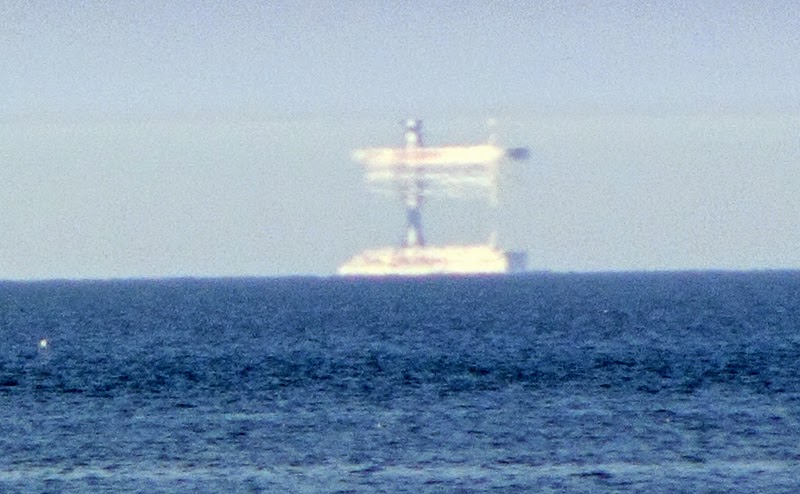
   Fine snow fell on the 17th, but then the weather cleared to reveal a beautiful sunset and a famous occurrence at the ends of the world, the Fata Morgana, a type of mirage.  Fata Morgana comes from the Italian name of Morgan(a) le Fay, the sorceress of Arthurian legend, as it was originally believed the flickering image above the horizon were fairy castles or false land created by witchcraft.  The scientific explanation is a bit more mundane, Fata Morgana occurs in calm weather and  is caused by a thermal inversion, when a clearly defined layer of warm air rests above a layer of cooler air. The upper-level warm air acts like a refracting lens and bends light rays to make distant objects, even those over the horizon, visible.  The actual thing itself is far from mundane, with fantastic distorted images of cliffs, ships, or buildings shimmering and ever-changing, often upside-down and even with several inverted and right-side-up images stacked on top of each other in the sky. Shackleton reports images of distant ice cliffs were seen in the sky in double and triple parallel lines, some of them inverted. He states this was probably due to open water near land causing the mirage.

Fata Morgana of a ship
   Mirages were a frequent occurrence in calm weather. On March 29th, barrier cliffs appeared all around the ship, even in places where they knew was deep water.  Shackleton wrote, "Bergs and pack are thrown up in the sky and distorted into the most fantastic shapes.  They climb, trembling, upwards, spreading out into long lines at different levels, then contract and fall down, leaving nothing but an uncertain, wavering smudge which comes and goes. Presently the smudge swells and grows, taking shape until it presents the perfect inverted reflection of a berg on the horizon, the shadow hovering over the substance.  More smudges appear at different points on the horizon.  These spread out into long lines till they meet and are girdled by lines of shining snow cliffs, laved at their bases by waters of illusion in which they appear to be faithfully reflected.  So the shadows come and go silently, melting away finally as the sun declines to the west...."
   Building winter quarters and gazing at mirages was not the only thing to be done.  The men began serious training for the dogs to pull the sleds, although they lost some dogs to stomach and intestinal worms.  The scientists continued to dredge the sea bottom for specimens. In addition to mud, they brought up rock fragments, pebbles, sponges, worms, brachiopods, and foraminiferae, a type of protozoa. One of their best hauls yielded a 75 lb lump of sandstone, a piece of fossiliferous limestone, a fragment of striated shale, sandstone grit, and some pebbles. On one occasion, they heard a great yell from Clark and witnessed him dancing about shouting Scottish war cries. He had apparently just secured his first complete specimen of a new species of Antarctic fish. (Ah, nerds.)
    From January 19, when the ship got stuck, until March 31, the pack had drifted 95 miles in a North 80 degrees West direction. The icebergs had not changed their relative position the entire time. As March moved into April, the sun sank lower in the sky and the temperature gradually dropped.  The surrounding ice began to thicken, and very little open water was to be seen.  They tried to get a wireless signal the morning of April 1, but again failed. Soundings of the sea floor indicated the sea was continuing to shoal, and gravel in the bottoms samples indicated they were nearing land.
    April was not without event. During the night on the 3rd, they heard ice grinding to the east, and in the morning saw ice that was rafted by pressure to a height of 8-10 feet.  The next day brought the prelude to what the ship would later face, ice was heard grinding and creaking and the ship vibrated slightly.  Shackleton gave orders that all the ice, snow, and debris which had accumulated around the Endurance should be shoveled away.  In case pressure increased, he wanted no extra weight on the ship to prevent it rising above the ice.  On the evening of the 15th an interesting phenomenon was observed. The sun set on a line of clouds just above the horizon.  A minute later Captain Worsley saw a golden glow, and then the sun reappeared above the horizon.  A quarter of an hour later, the sun set a second time. Of course, it was not the real sun, this was a type of mirage, which they attributed to an ice crack to the west, where a band of open water had heated the air.
    The sun set for the final time on May 1, so began the long twilight that would give way to the darkness of winter. On that day, the sun just cleared the horizon at noon, and set just before 2 p.m.  The company of Endurance, however, refused to lose their customary cheerfulness. Still, Shackleton knew the ice would not permit them to return to Vashel bay.  Although there were a few good landing spots on the western coast of the Weddell Sea, he was not sure they could be reached early enough in the coming year to make a journey over land possible.
   May dragged into June with little noteworthy event.  Whatever may come, the training and managing of the dogs was essential, and that took much of their time.  On June 15 they held the "Antarctic Derby" a race of sled teams.  Betting was heavy, wagers were placed with everything from money to chocolate and cigarettes. Five teams drove the 700-yard course, and the winner was Frank Wild's team, which ran the distance in 2 min. 16 seconds, or about 10 miles per hour.  Midwinter's Day was celebrated on the 22nd of June, with a twilight of about 6 hours and good light from the moon. Only necessary work was done, and after dinner, all hands gathered in the Ritz for speeches, songs, and toasts until midnight, when they sang "God Save the King."
    Beautiful sunrise glows in the early days of July heralded the return of the sun, which were soon followed, on the evening of the 13th, by the most severe blizzard they had experienced in Antarctica. During the blizzard the temperature ranged from - 21 to- 35 degrees F.  Temperature often rises during a blizzard, caused by warm foehn winds flowing down a mountain range.  The temperature did not rize in this blizzard, indicating there was no high land for at least 200 miles to the south.  Ice pressure was an increasing cause of anxiety.  Ice was rafting 10 to 15 feet high and cracks were opening everywhere while the ship was jarred with heavy bumps.  After seventy-nine days of darkness, the sun re-appeared above the horizon on July 26. Biologist Clark was happy because the returning light made diatoms return to the ice, as they cannot multiply without light.
    One year to the day since Endurance left England, Sunday August 1 1915, the ice that held the ship fast broke up suddenly.  All the dogs and sleds were brought aboard safely, but the ship presently listed to port against the currently blowing gale, and was forced forward at the same time. But as quickly as it happened, the sea subsided again, although the party was alarmed, and orders were given for all hands to stand by. In the breakup, a large lump of ice was wedged between the rudder and the stern post.  Although the men were able to pole the ice away, damage had been done.  Closer examination revealed the rudder had been pushed hard over to starboard and the blade partially torn away from the rudder head. The ice pack was still in chaos, with floes rafting and banging into each other, so repairs could not be effected.
   Four dogs had to be shot on August 3.  They were suffering horribly from worms and the party could not afford to keep sick dogs under such chaotic conditions.  The ice gradually settled down, until there was no open water to be seen nearby and no land could be viewed for 10 miles. The next day dog kennels were built on deck, and the sun was seen above the horizon for nearly an hour. Despite the upheaval of the ice,  nearly all the ice bergs within view stayed in the same position that they had been for the past seven months.
  By August 24, no land could be seen from the masthead within 20 miles. A sounding of 1900 fathoms the next day further proved the nonexistence of New South Greenland.  New South Greenland, also known as Morrell's Land, was supposedly sighted in 1828 by Captain Benjamin Morrell of the Wasp on a voyage in the Weddell Sea.  Morrell gave precise coordinates and a description of the coastline, which included mountains, and claimed to sail along the coast of this land for over 300 miles.  The problem was, no one who came after him could find land in that area.  And now that Endurance  was in that area and found no land whatsoever and very deep sea, New South Grenland obviously did not exist.  Still, Captain Morrell saw something, what was it?  It is suggested he saw a very large ice berg, (although even the biggest are not 300 miles long), he could have been mistaken as to where he was in the Weddel Sea and actually sighted the "Foyn Coast", which is part of the Antarctic Peninsula and about 14 degrees further west than New South Greenland was presumed to be. Or, most likely, Morrell was taken in by yet another Fata Morgana, the constant companions of polar explorers that reflect flat coastline in the sky to appear as tall cliffs.
Fata Morgana of nearby land

Iceberg in the vicinity of "New South Greenland" taken from Endurance, August 1915
   Late at night on the last day of August, the ice began to squeeze the ship again, cracking and groaning noises, along with occasional buckling of beams and planks continued through the next day. The day after that, September 2, a large sheet of ice was gripping the port bow about three feet beneath the water's surface.  Shackleton had hoped they would not have to march across ice to reach the land but, although Endurance was a strong ship, even the strongest ship could not withstand the deadly embrace of ice forever.

Thursday, May 21, 2015

A Nineteen Year Pilgrimage: Saluda, South Carolina

In some good cause, not in mine own,
To perish, wept for, honor'd, known,
And like a warrior overthrown.
~J. Hampton Kuykendall Sketches of Early Texians

      February 1996 saw my first of several visits to a place that would soon define part of my life, I trod hallowed  ground and visited the Alamo in San Antonio, Texas.  Very soon after, the story of that place and of all the great heroes that gave their lives there would capture my heart, and launch me into a journey that continues to this day.  I sought and still seek to learn as much as I could, and become intimately familiar with the lives of these men, the causes leading up to the siege, those fateful 13 days and what followed after.  Although not the sole reason, the Alamo is part of why I became an historian.
    I left Texas several years later, and beautiful San Antonio with her, but the Alamo I carried with me, or maybe a piece of me stayed there. It became a fortification against howling modernity, and a reminder to always be courageous.  Years passed and and I wended my way through Colorado (leaving myself there as well), Florida, and eventually to South Carolina.
  South Carolina! From its original refusal to approve the U. S. Constitution, to the Nullification Crisis, to the Secession itself, South Carolina is one of the most fractious states of the Union.  It is little wonder that such a place would produce two firebrands in  the form of William Barrett Travis and James Butler Bonham.  Of all the heroes of the Alamo, these two are the most dear to me. And when I found myself in the state of their birth, I knew I had to find the place where they stood.
   While still in college, I discovered that both were born on a fairly-civilized frontier near a town in 1809 as Red Bank, but was later renamed Saluda when Saluda County was created from the Edgefield District. I do not remember the exact year, but I believe I was yet in school when I also discovered that the house where James Bonham was born, known as Flat Grove, still stood.  It is only surviving birthplace of an Alamo hero.  When I discovered this place was extant, I vowed to see it for myself.
   Life got in the way for a while, Saluda isn't exactly near any large cities or major interstates so you can't visit it on the way to somewhere else. And Flat Grove is in a rather obscure place, only to be seen by appointment.  When I got around to being able to go, I found out the historical society had closed the house to visitors, and I all but gave up being able to see it ever.  Finally, early December of last year, I was browsing the internet and found that the Saluda County Historical Society had reopened the house after repairing it and partially furnishing it.  After the turn of the new year I determined now was the time.  I called the Historical Society and made an appointment.
   April 11, 2015 finally arrived.  Saluda, by the way, is South of Greenwood and Newberry, and almost due west from Columbia. We pulled into town a little early for our appointment, but there was an interesting looking monument in front of the courthouse.  We wandered over to it through the morning-damp grass, and I was presented with this.


  I didn't expect this,  and was speechless with awe.  This little out-of-the-way town held more esteem for these two than I realized.  I would later learn from the museum curator that James Butler Bonham and William Barrett Travis were inducted into the South Carolina Hall of fame in 2001.  Usually each year a living and a dead South Carolinian are inducted, but since Travis and Bonham were from the same place and died together at the Alamo, an exception was made and two deceased native sons were added to the rolls.
   The museum was wonderful,  I would have stayed there all day if I could have, as it contains everything anyone ever wanted to know about the history of the city and county of Saluda.  Plus, whole section dedicated to the Alamo, complete with artwork and an extraordinary diorama with hand-painted figures. All of the museum volunteers and society members have much love for their work, it was obvious.  Still, tempus fugit and I had to tear myself away from the museum to see the goal of my quest.
     Flat Grove is, as I said,  not easy to find without help.  Our two guides were marvelous.  The house originally was build in the flat lowlands along Richland Creek (hence the name Flat Grove). For preservation purposes, it has since been moved about a mile and a half back from the river, on a slight rise. Built by Jacob Smith in the early 1770s, the house has only belonged to two families:The Smith/Bonham family sold the house to Henry Conrad Herlong in 1856.  The Herlong/Boyd/Matthews family deeded it to the Historical Society in 1989.  I suspect the land that the house sits on belongs to the second owners since two roads that lead to the house are named Herlong and Boyd's Branch.  When the house had been deeded to the Historical Society, two rooms had already fallen to the ground, and the house was declared not salvageable.  But Bonhams don't admit defeat so easily.  Flat Grove was taken apart piece by piece, transported and lovingly reassembled where it now stands.
   When I saw the house, it took my breath away, the quest had been fulfilled.
 "Come down, come down sweet reverence, unto my simple house and ring". ~Gregory Alan Isakov The Stable Song
  Though it doesn't look like much now, it was a mansion in its day.  The house was originally built in a "dog-trot" style (one room on each side with a breezeway in the middle), then the breezeway was later enclosed, two more rooms built behind, and two rooms above.  Finally, in the early 1900s a kitchen and porch were added to the very back of the house. The exterior has never been painted, and many of the interior rooms still have the original blue-tinted paint, probably made with indigo. (Indigo and rice were the major cash-crops of the low-country plantations).

Entrance hall (former dog-trot) of Flat Grove, note the blue paint

One of the two front rooms, the oldest part of the house. Do you think James B. Bonham stood on these floorboards? 

The original stair case was enclosed when the newer one was built, but still functional. Dad added for perspective.
One of the rooms built behind the original rooms. The bed belonged to the last family to own the house. Also more indigo paint. 

Fireplace in one of the upstairs rooms. 
       Like the museum, I could have spent all day at Flat Grove. But, while at the museum, the curator had mentioned a Travis Monument. Of course, this I had to see, so we climbed back into cars and followed our worthy guides down the road.  True enough, at the junction of Highway 121 and Rocky Creek Road sits this, front and back.


   Across the road from this monument is land that was the original Travis homestead.  The land is privately owned, so no public access is allowed, but I there are unmarked graves not far from the road that are presumed to be Travis family members, including William Travis' grandparents, Berwick and Ann Travis.
  By this time I decided I might as well take the grand tour, so we went on a short distance down the road to the Marsh-Johnson house.  While not associated with the Bonham or Travis families, this house is one of the oldest in the area and was at one time a plantation house and tavern. It sits  at the corner of Rocky Creek and Fruit Hill roads, along one of the earliest roads through the region. Usually the term "plantation house" conjures mental images of 50 roomed, white columned mansions right out of Gone With the Wind, but most of them were probably much like this.
The Marsh-Johnson house, with anachronistic security system, which doesn't keep squirrels out.

     Marsh-Johnson is smaller than Flat Grove, and about 40 years younger.  It was built sometime between 1804, when the land was sold to Bryan Marsh, and 1825 when the house appears on a map of the area. It has been restored and is in very good condition, despite the persistent squirrel problem. There are six rooms total, a large front room, a smaller parlor to the side, Two large rooms upstairs, and then the back porch was later enclosed to make another room and a kitchen,  Except for upstairs, this house is fully furnished, and has electricity.
    Like Flat Grove, the interior walls are painted a blue, probably with the same type of indigo dye. The stairs, while still unwieldy in the dark, are better built than the original staircase at Flat Grove.
The front room of Marsh-Johnson

The parlor to the side of the main room, decorated as a Ladies' Parlor

The back bedroom

One of the two large rooms upstairs.  I'm not sure I'd be keen on staying up here with half  a dozen or so strangers.

The kitchen, added later by enclosing the back porch and decorated 1940s style
   The twin chimneys of Marsh-Johnson are quite interesting.  The pattern is called a Flemish Bond and is made by alternating headers (the short end) and strechers (the long end) of the bricks.  This actually makes for a stronger structure than just using the long sides of the bricks.  The headers are glazed with a blue glaze that is still apparent.  Such glazing and the Flemish Bond pattern indicate this house was built for a person of some wealth.


Blue glaze of the brick headers

   So that was Saluda.  I took my leave of the houses, the land and the charming and helpful museum staff. Once I returned home, it was in the following days that I realized I had left part of myself behind again. I had left a piece of myself beneath the floorboards of one of the most beautiful houses I had ever seen (not for its looks, but for who came from it), and another piece in a spring-greening field that likely held the bones of a once indentured servant whose grandson would sign "Victory or Death" to a plea for help in defeating a tyrant, and thereby send himself an another 180 odd men and women into Apotheosis. The story of the Alamo is the story of South Carolina and America as a whole, as much as it is the story of Texas. For the first time in 13 years, I feel like I am home.

   I would also like to give my sincere thanks to all the volunteers at the Saluda County Historical Society.  They were informative, helpful and very accommodating.  If they ever see this, I hope they know how appreciated they are.