Saturday, October 18, 2014

Wringing the Last Drops of Innocence from the World

   "Never such innocence,

Never before or since,
As changed itself to past
Without a word – the men
Leaving the gardens tidy,
The thousands of marriages,
Lasting a little while longer:
Never such innocence again."
MCMXIV by Philip Larkin


Casual historians today tell the story of the First World War as if Bang! The Archduke gets shot, and Bam! everyone started shooting each other.  In reality, the whole thing was far more complicated. For a while after Archduke Franz Ferdinand was assassinated, the Crisis of 1914 was seen as just a small dispute between Austria and Serbia.  A local problem best left to the two participants to sort out between them. Then, when it looked like there really would be a huge war, everyone stood around for a while deciding whether or not they really should start the whole thing or just talk each other out of it.
   Local crises like the murder of the Archduke had happened before, for example European quarrels over who owned what in Africa, or the Balkan Wars of 1912-13.  These had mostly been settled by a few shots fired and some diplomacy, but they had touched only matters of national interest.  The death of Franz Ferdinand was a matter of national pride.
    Austria was the weakest of the European powers, and was therefore also the most sensitive. A very multicultural, multi-religious, multi-ethnic territory, Austria-Hungary lived in fear of ethnic subversion. When the heir to the throne was killed by a member of the most subversive minority, it was too much for Austrian sensibilities. An investigation revealed that the terrorists were Austrian subjects, but they had been armed in Serbia and the smuggled across the Austria/Serbia border by Serbian nationalists. This national organization was the Narodna Odbranda (National Defence) which had been set up in 1908 to work against the incorporation of Serbia into the Austrian Empire. Narodna shared members with another nationalist organization,"Union or Death" better known as The Black Hand. They wanted to unite Serbia, it was actually from The Black Hand where there terrorists had come.  This secret society was under the control of an individual code named "Apis" who was the commander of the Serbian Army's General staff.  No one is still quite sure how much the Serbian government knew about the plot.  However much they knew, it was enough to confirm to Austria that Serbia was nothing but trouble and was best punished for their crime.
    The Serbs were Orthodox Christians, which made them a religious as well as ethnic minority. Their religion, however, made them the darling of Russia.  Austria knew this, and to were hesitant to take action against Serbia. Russia aside, Serbia was not well-liked among most of Europe.  In 1903, the Serbs had killed their king and queen and then thrown their bodies out a window and hacked them to bits with swords.  This shocked the rest of Europe, even sympathetic Russians and Bulgarians, and no one was really keen on defending people that did this to their sovereigns.
   The assassins confessed to Serbian complicity in the crime on July 2. Austria had long wanted to get Serbia out of their hair and this was a perfect excuse. Austria made its position clear a mere six days after the assassination, but would not dare to act if they could not count on backing from Germany. This was a mistake on Austria's part.  Everyone else, even Russia, wasn't all that interested in Serbia. If Austria had struck immediately, without waiting to see if Germany would help them, the rest of Europe might have let Austria do what it wished with Serbia and passed it off as a local problem.
    Over lunch on July 5, Kaiser Wilhelm II told the Austrian Minister, Count Berchtold, Austria would have Germany's support. The German Foreign Office was informed the next day that Britain would not get involved in a Balkan crisis, nor would Russia and France. Satisfied, the Kaiser departed on the imperial yacht, the Hohenzollern, for his annual cruise to the Norwegian fjords. Before he left, the Kaiser insisted on one thing, Austria needed to come to a firm decision on waht it wanted to do. Austrians were known for what Germany referred to as Schlamperei, a mix of prevarication and procrastination which often irritated  Germans to no end.  Kaiser Wilhelm feared the same was about to happen this time. Oddly enough, in the first weeks of July the roles were reversed; Austria wanted action, Germany went on holiday.
    Tuesday, July 7 was ten days after the assassination when the Imperial Counsel of Ministers finally met. Count Berchtold wanted to go to war, The Hungarian Prime Minister, Tisza, insisted that a list of demands be sent to Serbia first. If they rejected the terms, then they would be sent an ultimatum that led to war. They argued over this for a while, and then turned it over to the Emperor. Franz Josef agreed that Serbia should be given terms first, to Berchtold's dismay.  By July 14th, Berchtold and Tisza drafted the terms and set the date for the terms to be approved. The date chosen was July 19, twenty days after the assassination. Even worse, the note would not be delivered to Serbia for at least another week.  Why? Because the President of France was going on a state visit to Russia and Austria/Germany did not want their note going out when two potential allies to Serbia would be in close contact with one another. With France and Russia together when the terms were sent to Serbia, it would lessen the chance conflict with Serbia remaining a local problem, and make it more likely that France and Russia would come to Serbia's defence.
       The French president was scheduled to leave Russia on Thursday, July 23rd. Austria's terms would be sent to Serbia on the same day and would expire at 6 o'clock in the evening (local time) of the 25th. In short, the terms imposed the arrest, interrogation, and punishment of Serbian officials implicated in the assassination.  They also insisted Austro-Hungarian officials should take part in the process on Serbian soil.  Translation: Austria-Hungary did not trust Serbia to handle the crime itself.
   Twenty-five days since the assassination had passed, and the Serbian Prime Minister, Nicholas Pasic, was warned the note from Austria with terms was on its way. Despite this, he left  Belgrade for the country. During the night he had a change of heart and returned to the city, and met with his ministers the next morning. France, Britain, Germany and Russia had by this time all received copies of the note, although France was currently in the hands of a deputy since the president and foreign minister were at sea. Meanwhile in Belgrade, the British minister was ill, the Russian minister had just died and was yet to be replaced, the French minister had a nervous breakdown and his replacement had just arrived. Messages from London and Paris urged Serbia to accept as many of the terms as they could, but the Serbians were still deciding. With Serbia humiliated and everyone else mostly just standing around not knowing what to do, the murder of the Archduke was still a matter between Austria and Serbia and not really any other country. The British Foreign Minister, Sir Edward Grey, left London for a weekend of fishing.  At this point I am beginning to wonder how this war got started at all.  We're deciding on whether or not we should end civilization as we know it and everyone goes on holiday!  Although, there is something to be said for prolonging the inevitable, and wringing those last drops of innocence from the world.
   Serbia was still considering the terms from Austria when word reached them the mood in the Tsar's country palace was very pro-Serbian.  This emboldened Serbia to reject the most important of Austria's terms, that Austria would take part in the investigation of the assassination. Tsar Nicholas, meanwhile, announced a  "Period Preparatory to War", where Russia would think about thinking about mobilization.  At this, Serbia began mobilizing its small army, and Russia recalled the youngest reservists from its western districts.  Aside from this, for two days not much else happened. Germany warned Russia that if it fully mobilized, it would cause Germany to mobilize its army which would mean war. Britain and France began working to restrain Russia, which seemed to work, Russia moderated its position and so did Germany.  For an instant it looked like this crisis could be negotiated away like so many before.


Kalimegdan or Belgrade Fort

    If only, if only! Few realized what a flash point the mobilization of Russia was until after the fact. While Britain and France were trying to talk Russia down, Austria-Hungary declared war on Serbia Tuesday July 28, officially beginning the War to End All Wars and start a hundred others. Austria began bombing Belgrade the next day. Horrible as that sounds, the attack was really just a pinprick. The fort that was shelled, Kalimegdan, an old Turkish fort at the meeting of the Danube and Sava Rivers, still stands to this day. Also on the 29th, Russia began partial mobilization. That afternoon, Kaiser Wilhelm telegraphed his cousin, Tsar Nicholas, and asked him to smooth over difficulties between Austria and Serbia,  Nicholas replied "It would be right to give over the Austro-Servian problem to the Hague conference." The international court that Nicholas himself had invented to handle such crises which no one seemed to want to be a member of. Wilhelm telegraphed back asking Russia to remain a spectator,  Nicholas had a change of heart and recalled the mobilization orders that evening. The Tsar, on holiday along with everyone else it seems, was at his summer residence. He was being badgered by his cabinet about what might happen if they didn't mobilize,  Finally giving in, Tsar Nicholas gave the order for the first day of mobilization to be July 31, thirty-four days since the Archduke had been murdered.
   The next day saw Germany's mobilization, while France fell into despair when Britain still refused to get involved. Britain was disconnected from the rest of Europe, both geographically and in ties of diplomacy, and she still believed that the primary offending parties could be talked out of their current positions.  August 2 saw Germany deliver an ultimatum to Belgium, which would expire in 24 hours. This was the causus belli for Britain, they told Germany to stand down or else. The Germans refused, so at midnight on August 4, Britain and France collectively declared war on Germany. Austria managed to delay its declaration of war on Russia until the next day, August 5 and was still not at war with Britain and France a week later.  The two Allies made up dithering Austria's mind for it by declaring war on Austria August 12th. Italy, meanwhile, would remain neutral for the time being and Serbia, the cause of all this woe? War would not come to their country for another 14 months.
    Modern forms of communication overload those who use them.  Valuable information is lost as we try to separate what is vital from what is not, and drown in the onslaught. In 1914, everyone was plague by the opposite problem "underload." Information about who was doing what trickled in slowly, if at all, and was usually incomplete. No one had any idea what everyone else was up to, nor could they get advice from anyone else on how to respond.  (It probably would have helped some if most of the main decision-makers hadn't all gone on holiday at once.) In the dreadful in-between, the gaps of information that had to be filled in, everyone deliberated, thought, acted and then rescinded, and finally just made the choice and prayed it was the right one.

Thursday, August 28, 2014

Ad Infernum: The Edge of Civilization

    To talk about the bottom of the universe
the way it truly is, is no child's play,
no task for tongues that gurgle baby-talk. ...

...In the depths of Austria's wintertime, the Danube 
never in all its course showed ice so thick, 
nor did the Don beneath its frigid sky,

as this crust here; for if Mount Tambernic
or Pietrapana would crash down upon it,
not even at its edges would a crack creak.

~Dante, The Divine Comedy: Inferno, Canto XXXII

 As mentioned previously, Shackleton had volunteered all the men and supplies of his Trans-Antarctic Expedition, without consulting his donors, to the war effort as soon as Britain declared war on Germany. He was thanked but told they were not needed since the war would likely be over in a few months. So Endurance set sail from Plymouth on August 8, 1914 heading for Buenos Aires. Shackleton had been detained by expedition business, so he did not depart on the ship. He took a faster ship to Buenos Aires and met with the rest of the crew there.I do not know what day Endurance reached Buenos Aires, Shackleton does not mention it in any of his published writings. Perhaps, because he arrived separately, no one bothered to mark it. The voyage from Plymouth to Argentina would probably take about two months.  They departed Buenos Aires on October 26 and came to Grytviken, the whaling station at South Georgia, on November 5.     South Georgia is the largest and northernmost of a chain of islands known as South Georgia and the South Sandwich Islands.  It was then and still is a British Overseas Territory. Britain had claimed South Georgia since 1775 but had only taken over the South Sandwich Islands in 1908, six years prior.  Back in 1914 they were known as the Falkland Islands Dependencies. Grytviken was the main settlement there, a whaling station (where whales were brought for processing after being killed by whaling ships) and literally the end of civilization. Past Grytviken there was nothing, no towns, no radio, no telegraphs, no people. Today there are a few research stations in Antarctica so one is never very far from at least other humans, but Shackleton and Company were completely on their own.   The whalers at Grytviken had warned Shackleton about ice around the South Sandwich group, they had seen ice come all the way up to the island chain even in summer (which it was now), and said the best time to get into the Weddell Sea was probably late February or early March.  The Weddell Sea is the large bay facing the South America side of Antarctica. (I would say the North/West/or East side, but at the bottom of the world, there is really only one direction to go, North.


South Georgia, taken by Frank Hurley

    The ship departed Grytviken on December 5, 1914. They had hoped a steamer would arrive at the station to bring mail and news of the war before they had left, but they tarried long enough and had to leave while the ice pack was at least barely passable. A year and a half later they would learn that the steamer Harpoon had arrived with mail just two hours after Endurance departed. Passing through the South Sandwich islands on the 7th of December, they met their first ice at 57°26’ south latitude. Many icebergs, tabular in shape and yellow with diatoms, were seen west of the islands.  Two hours later, the ship encountered its first band of heavy pack ice. Although the whalers had said ice came as far north as the southern end of the islands, Shackleton was had not expected to see it this soon.
    Why was there ice this far north? Even today, when Antarctica is supposedly warmer, pack ice comes as far north as the Southern Sandwich Islands in winter.  Also, 1914 was a mere 64 years after the approximate end of the Little Ice Age, and the climate was still coming out of that. Only two years prior had benen the great maritime tragedy when Titanic struck a berg in the opposing hemisphere in a place were ice is now less common.  Titanic herself was only a few miles from pack ice in the north Atlantic when she struck the berg that was her undoing. Indeed, there is a theory that the Great Ship did not hit an iceberg but pack ice.  If pack ice was that far south in 1912, then it is no surprise that it was that far north of the South Pole in late spring two years later.
  Thus began the process that would become routine most of the way south.  Sail or steam through leads in the ice as they found them, break through the ice when there were no leads, or when the wind was driving the ice floes so close together they were impassible, shut off the engine and wait.  During colder weather, water that was exposed between floes would soon freeze over in a matter of hours after putting off "frost smoke". Often, they would have to break through the ice by driving the ship against a floe at half speed, stopping the engines just before impact. The ship would then ram into the ice and cut a V-shape into the floe, and often the impact caused the ship's bow to rise nearly out of the water and roll slightly. After ensuring loose bits of ice would not hit the propeller, they then reversed the engines and drove the ship back 200 to 300 yards. They would then drive the ship forward and hit the V in the center. This would be repeated until, usually on the fourth attempt, the ice split and they could sail through. Sailing through these ice floes required muscle as well as nerves. One day, while navigating and breaking through the ice, there was a great nose aft. Leonard Hussey, meteorologist, was at the wheel and explained "The wheel spun round and threw me over the top if it!" This was no pleasure cruise.
       It wasn't all monotonous ice-splitting, though. There were sled dogs to train and give names to like Rugby, Upton, Saint, Caruso, and Slobbers. Shackleton and Company did a good deal of whale, penguin and seal spotting, as often as not they would hunt the animals as well. This was not so much for sport as to add to their food supply. Then of course there was fun to be had at the scientists' expense. One of the standing jokes on the ship was that the Adelie Penguins they saw quite often all knew biologist Robert Clark, and when he was at the wheel would run alongside the ship squawking "Clark! Clark!" and seemed to be disappointed that he never answered. Some of the men would later put a few strands of spaghetti in a jar and present it to Clark as some new Antarctic worm they had found.  At one point while trying to run through some ice, the captain had the semaphore hard-a-port, but the ship would not port. The captain shouted to the scientist who happened to be manning the wheel "Why in Paradise don't you Port!" The indignant reply came "I am blowing my nose!" Ah, scientists. Even they were required to steer the ship through the ice floes.
    The penguins, in addition to acquainting themselves with Clark, also seemed to have a taste for music. One afternoon, Hussey was playing the banjo on deck and three Adelie penguins approached the ship. They apparently very much appreciated "It's a Long Way to Tipperary" but, according to Shackleton, "they fled in horror when Hussey treated them to a little of the music that comes from Scotland." The roars of laughter from the crew dismayed the little birds even more, and they ran off as fast as their short legs would go.
      Christmas Day 1914 found Endurance stuck in heavy ice floes from midnight to 6:00 a.m. then the ice opened and they made progress until about 11:30 a.m., when the ice closed in again. During the early part of the night, they had good leads and easily broken ice.  They made more progress that day then the had and of the prior two weeks.   On the other side of the world, Germans and British soldiers on the front lines were calling a temporary truce for Christmas.  They would get back to killing each other the next day. Meanwhile,  the crew of the Endurance had grog at midnight for all on deck, and grog again breakfast for those who had been asleep at midnight. Thomas Orde-Lees, the storekeeper and motor expert, had decorated the wardroom with flags and had a little present for each of them. Later came a dinner of turtle soup, whitebait, jugged hare, Christmas pudding, mince pies, dates, figs, and crystallized fruit, with rum and stout.
  New Year's Day, 1915 came, and since the ship had entered pack ice in December, they had made 480 miles through the ice. Shackleton reckoned the total steaming distance to be 700 miles. So 220 miles had been spent sailing along and around ice finding a way through to open water. They had made good progress considering the ice and the winds that had barred their crossing. But winter was quickly on it's way, and they were still not within sight of land.
 

Colorized photograph of Endurance in full sail

Thursday, July 31, 2014

Sister Russia and Our British Cousin. The Trouble with Allies

   "Knowing others is intelligence; knowing yourself is true wisdom"  ~Lao Tzu   


    If you are going to war against a country larger and more powerful than you, you will need allies. At least one, preferably more. In 1914, no one was more aware of this than France. Germany and its satellites were at least 20% larger than France and its population was half again as large. France's primary ally, really its only confirmed ally, was Russia.
  Russia, however, was a constant cause of trepidation to France because it refused to confirm just how much it would thrown in with France when war began. Russia wasn't intending to be malicious with its vacillation, it had its own problems to deal with, and its sheer size and distance from Germany made the way it could wage war different than France.  If Germany started a two-front war, France was immediately in the cross-hairs. It would be the first thing Germany went for.  Russia was so far away that by the time they reached even the borders of Germany, France could have fallen. Russia's distance from Germany allowed it to wait a few days to mobilize. It was also large enough that it could endure a initial (relatively) small loss of territory to the Germans while calling up their reserves.
   Size and distance aside, Russia also had its own problems at home without having to worry about its comparatively small ally. They had just come through a humiliating defeat by Japan in the Russo-Japanese War in 1904-05. That war, considered the "first great war of the 20th Century" was an imperial dispute between Russia and Japan over Manchuria and Korea. After that, Russia had a minor revolution in 1905.If Germany had implemented its Schlieffen plan in 1906, it probably could have wiped out both France and Russia.  But by 1909, Russia was starting to pull itself together again and work out its own mobilization schedules in the event of another war.  Indeed, the mistakes Russia learned from in 1904 helped it to defeat Germany in 1917. After much waffling, Russia surprised everyone by throwing in its lot with France in 1913.      There is still speculation today as to why Russia seemed to have a sudden change of heart. One possibility is that Russia had an Austrian double agent that sold them the secrets of Austria's war plans. Another is that Russia finally got over its defeat by Japan and was militarily and economically to the point where it could start expanding again.  Or perhaps Russia just realized that if France fell, it could not stand alone against the combined force of Germany and Austria-Hungary. Whatever the cause, the idea of having Russia coming at them from behind while they attacked France certainly gave Germany pause.
    Germany was not without its own ally problems. Germany's main ally was its smaller associate to the south Austria-Hungary.  Austria-Hungary vacillated on whether it would or would not help Germany in the next war.  While Austria-Hungary was more interested in taking on Serbia, Germany intended to throw Austria at Poland to keep back the advancing Russian army while they dealt with France. It was not until summer of 1914 that Austria-Hungary finally agreed to engage Russia, and only if Germany guaranteed they would grant them a portion of the German forces to assist.
    Russia aside, the one thing Germany did not consider was Britain getting involved. France couldn't really count on Britain either, because Britain had strongly implied that they did not want to get involved with anyone else's problems.  Britain had an advantage that the rest of Europe did not have, isolation.  They were separated from everyone else by water, while the rest of the countries were separated by a river or mountain range at best, at worst, just a line on a map.  While the rest of Europe had to worry if a conflict elsewhere would spill over into their land, Britain could stay out or choose to get involved, and with whom.  Britannia also had the largest and most powerful navy in the world, although Germany was fast catching up with them. Indeed, if conflict did start, that is how Britain at first planned to engage Germany, by putting its impressive British Navy against the German High Seas Fleet.   Over time, however, the British government and military came to realize that if Germany was the aggressor, the decisive point of battle would lie in France, and it was there they would have to go.  They came to an agreement in 1911, and France added Britain into their battle plans, while Britain went to work determining the fastest way to send soldiers over the Channel. France and Britain had never really gotten along, in the past they went to war against each other as often as not, but this time they would operate on a "the enemy of my enemy is my friend" policy. Stop the enemy from invading you before he invades us both.
     Everyone had been making plans and stockpiling weapons and men for years. Planning moves and counter moves, trying to anticipate the other side's reaction to their advance.  The board was set.  All that was needed now was the opening move.

Saturday, July 12, 2014

Deutschland Uber La Marseillaise: The German-French Hostility

"From the lands where the sun rises to western shores, people are crying and wailing ... the Franks, the Romans, all Christians, are stung with mourning and great worry ... the young and old, glorious nobles, all lament the loss of their Caesar ... the world laments the death of Charles ... O Christ, you who govern the heavenly host, grant a peaceful place to Charles in your kingdom. Alas for miserable me."

Anonymous Monk at the monastery of Bobbio, on the death of Charlemagne

With all this talk about Germany wanting to war with France and France wanting to war with Germany, I really have not clarified why these two neighboring countries wanted to destroy each other so terribly.  Allow me to pause here and explain, at least in part, why they were both spoiling for such a war.  It is not an easy story, for it is a very complicated tale, with many causes and many players. One could spend literally a lifetime studying and writing about the enmity between these two countries. I shall endeavour to put it in a very large nutshell.
    As with most things in Europe, it begins with Rome. Julius Caesar in his On The Gallic War comments on he rivalry and cultural differences between the Gauls, living in what is now France, and the Germanic tribes in present day Germany. The Gauls were a Celtic people who inhabited a territory bounded by the Rhine river on the East, the Atlantic Ocean on the West and North, and the Pyrenees Mountains and Mediterranean Sea to the South. This still corresponds to the borders of modern day France.Once the Gauls were conquered by Julius Caesar, they became thoroughly Roman. Roman citizenship, running water, baths, forums, circuses, speaking Latin and so on. 
   The neighbors across the Rhine were a different story. They were not Celts and they had no interest whatsoever in being Roman. They were the barbarian Germanic tribes. We don't really know what they called themselves, Julius Caesar calls them Germani because that is what the Gauls called them. Rome tried to conquer them too, but after losing three legions to the Germans in the disastrous Battle of the Teutoburg Forest, the Romans pretty much gave up and went home.  In fact, this battle all but ended any further Roman expansion into northern Europe. The hero of this battle was the chieftain of the Cherusci tribe of Germans named Arminius, Armin, or Hermann, depending on what language you are speaking. Remember him and remember Teutoburg Forest, they will be important later. 
   So we have the Roman Gauls and the very un-Roman Germans living on opposite sides of a river. This is why French is considered a "Romance" language while German is not. French has a lot of Latin in it while German has hardly any Latin in it at all, save for a few words. After Rome fell, what is now France and most of Germany was united under the Franks. Though they gave their name to France (i.e. Francia), they were actually a Germanic people who spoke a language that was more German than Latin Gaulish.  Clovis I was the first king of the Franks to unite all the Frankish tribes. He was of the Merovingian Dynasty and is still considered the first king of France. His name, Chlodowig in its original Frankish form,  would later be transformed to Louis in French and Ludwig in German. The Merovingians were later overthrown by the Carolingian Dynasty, founded by Charles Martel, whose grandson would be the most famous Frankish king and one of the most legendary monarchs of all Europe: Charles the Great, Carolus Magnus, Charlemagne.   Charlemagne united all the Franks in Francia and all the German Franks, he conquered south to take northern Italy and west to unite all the territories that would later make up Germany and parts of Austria and Hungary.  Being a Christian, he went to war with the Muslims in Spain and put Pope Leo III under his protection after the Romans tried to put out Leo's eyes and tear out his tongue.  On Christmas Day A.D. 800, Pope Leo III crowned Charlemagne Emperator Romanorum "Emperor of the Romans", declaring the Frankish king the rightful heir to Old Rome. This was a slap in the face to the Byzantine Emperors in Constantinople, who considered themselves the continuation of the Roman Empire.  
   The crowning of Charlemagne founded the Holy Roman Empire, whose ever-changing borders over time would contain all of Germany, most of Austria and Hungary, northern Italy, all of Switzerland, Belgium, and the Netherlands, and parts of Poland and France. When Charlemagne died, he was succeeded by his son Louis who only kept the empire intact in his lifetime. Upon Louis' death, two of his sons divided the kingdom between them into two territories that became later the countries of France and Germany. 
  So, after some nice Christian and Roman unity, it's time to start hating each other again. France, throughout the middle ages into the modern era sought to maintain the borders it had since it was Gaulish Rome as described above, but France was the main nation that went on Crusades, fought wars against the Spanish and the British and owned England itself for a time. France was sophisticated and outward looking. Germany sort of kept to itself and ignored everyone. (Beware the loners, they're usually not quiet so much as plotting.) Also, France was united into a single country.  Germany, or the Holy Roman Empire as it was known, was a collection of smaller territories ruled by lesser kings under a greater emperor. It stayed this way until the early 19th century when Germans started thinking about unification. They were finally driven to unify in 1870 with the Franco-Prussian war. The Franco-Prussian War starts with Napoleon. 
     The Napoleonic Wars are well known enough that they do not need to be discussed here. Let's just say that the German States were very angry with France for the way it had run over them on its way to Russia and Poland. To prevent such a thing happening again, Prussia, the largest and most powerful of the German states, began uniting the norther German territories. This suddenly upset the balance of power in Europe, and Napoleon III, Emperor of France, demanded compensations in Belguim and the left bank of the Rhine, including two little territories largely full of German-speakers known as Alsace-Lorraine. Otto von Bismark, the Prussian Chancellor refused, and turned around started to unify the southern German states with the new northern state, creating modern Germany.  This is where Arminius and Teutoburg come back in. After the Napoleonic Wars, Germans began writing plays and songs about Arminius and his defeat of the French Romans. This even was looked back to as a key point of German identity. 
   France did not want Germany to unify because it would make a country larger and more powerful than itself. France attacked Germany and newly unified Germany responded. They responded by marching all the way to Paris and laying siege to it, intending to starve the French into submission. Finally, an armistice was signed in 1871, less than a year after the war started. Flush with victory, Germany demanded Alsace-Lorraine from France and built a monument to Arminius in Teutoburg Forest, with his statue glowering toward France. 
  So on top of everything that had gone before, the final bone of contention between these two countries was this. France felt threatened by unified Germany, newly unified Germany wanted to start taking back some of the territory it had as the Holy Roman Empire (and didn't want France attacking it again) and France wanted Alsace and Lorraine back. They couldn't wait to start going at each other again. In August 1914 they were only to glad to start going at each other again. 

Saturday, July 5, 2014

The Great Game

"All warfare is based on deception. Hence, when we are able to attack, we must seem unable; when using our forces, we must appear inactive; when we are near, we must make the enemy believe we are far away; When far away, we must make him believe we are near."
Sun Tzu, The Art of War


    Aside from making war, there is another occupation that armies have which is no less important, making plans. Without plans, there is no way to win a war. Alexander the Great planned how to invade Persia, Hannibal planned how to cross the Alps (with his notorious elephants and boulder dissolving vinegar) to take over Rome. Philip II of Spain planned to sail the Spanish Armada to England in 1588, only to have to tables turned on him. Napoleon made war plans almost every year of his conquering career. The North planned how to defeat the South in the American Civil War and so on.
    All of these plans, indeed pretty much any war plans since men began the art of war, were made "on the hoof" when war was either impending or already ongoing. That would change by 1870, with the advent of the new European railway systems which made it possible for armies to move thousands of men long distances ten times faster than they could travel by foot. The railroads also made it easier to supply armies, since food and other goods could be shipped to troops by rail, rather than having to rely on what could be begged, borrowed, bought, or stolen from the surrounding countryside.  The trouble with railroads is, they have to be efficiently timed or nothing will ever go anywhere.  The French army learned this the hard way during the Franco-Prussian war, when empty train cars left sitting on the track blocked the arrival of full trains for miles. Because of this, armies became fixated on ensuring that trains were kept to a strict timetable in war as well as peacetime. The best place to do this was staff colleges.
   Staff colleges were an invention of the latter Nineteenth Century. As mentioned before, soldier-making had become an industrial staple of most European countries, and since armies and navies need officers, staff colleges were set up to train privileged young men to be such. The first staff college was, not surprisingly, founded  by the Germans the same day the University of Berlin was founded. At first, the attendants of these schools were trained to be minions, but later on they were taught to think like generals, play war games, study military tactics, and write solutions to strategic problems. Germany was the founder of the staff college/war college and its models were soon coped throughout Europe. Their tactics were copied and their manuals translated into English, French, and other languages. The best graduates were appointed to general staffs and set to arranging mobilization schedules, writing wartime railway timetables, and finding solutions to every possible outcome of a situation.  Nineteenth century warfare had been turned from something done on an as-needed basis to an intricate art, a trade craft.  An obsessive, giant chess game with the map of Europe as the playing board.  The opening move was designated Mobilization Day ( M-Tag as it was known by the Germans) and everything following was a rigorous schedule of what soldiers and supplies should be placed where and when however many days after M-Tag until they reached the battlefield and the war was won.


The Schlieffen Plan

   As in chess, there are always strategies, and this new art of war was no exception. Generals and their staffs would write out various plans of deployment based on the situation and how they expected their opponents to respond.  These deployment plans, once complete, were pigeon-holed to be pulled out later as needed. The most famous of these is still known even to casual students of history, the Schlieffen Plan.
The Schlieffen Plan was named for its author, Field Marshall Alfred von Schlieffen, and was in short, a plan of how Germany was to crush France once one of them declared war on the other. The Plan was this, nearly the whole German army in a line, hinged at the Swiss border and stretching nearly to the North Sea, would march forward in a large arc across Belguim, Brussles, and finally across Flanders to the French border. The were scheduled to reach the French border by 21 days after M-tag. On the 31st day after M-tag, the German line would run along the Somme and Meuse rivers and the right wing would turn south, enveloping Paris in a pincer-like movement,  driving the French army toward the left wing that was advancing from Alsace-Lorraine. Thus in a gigantic claw, 400 miles in circumference and 200 miles wide, France would essentially be decapitated as her army was crushed.
   This plan would continually be plagued by problems, how long would it take supplies to get to the front, how hard would resistance through Belgium be, and so on. Schlieffen would continue to tinker with his plan obsessively until he died in 1912. His colleagues and successors would also continue to tinker with it. He and the other Germans were unaware that the French had a very similar plan in their war plan index. Known as Plans XIV-XVI, they were all variations on the same theme, to send all of the French forces along the French frontier to block Germany from entering France. It was a mirror of Schleiffen's masterwork, and plagued by the same problems; troop movements, supplies, ect.  If both of these plans had been implemented as written, there would have been gridlock in Belgium and Alsace-Lorraine that may just still be going on today. Fortunately these two armies mobilized in slightly modified versions of their dress rehearsals.
   France had a smaller population and therefore a smaller army than Germany, but remedied this in part by the Conscription Law of 1905, which imposed two years of military service for all young Frenchmen. Germany responded in kind in 1911 with a three year law for all young German men. Thus the world ran back and forth for thirty odd years, laws were changed, battle plans were written, rewritten, and indexed up until zero hour. This is what the staff colleges of Europe did during peace time. It is really no surprise that everyone wanted to go to war so desperately, the were all probably bored. One can only play the world's biggest chess game for so long.
   Oddly enough, there were no diplomatic equivalents of military staff colleges. They cataloged ways to make war, but not ways to make peace. Oxford University had established its professorship of Modern History in the eighteenth century to educate future diplomats, but up to 1914, the British Foreign Office was still choosing its entrants from honorary attaches; that is, young men whose fathers were friends of ambassadors. ("It's not what you know, it's who you know" is at least two hundred years old. It is not a new thing.) Diplomacy was therefore, mostly taught in embassies. European diplomats ante-Great War were a truly international class, they all knew each other as acquaintances or friends and all spoke French as a common language. And they all shared the belief that it was their main job was to avoid war.
    They had done so in the past.  At times when it looked like Europe was on the verge of war they all had enough confidence in each others abilities, a common standard of conduct, and desired above all else to prevent conflict. It was not the fault of the diplomats in 1914 that war finally consumed the world, why did they fail? I am not quite sure of that answer, I am still determining the threads of action and consequence.  The nearest I have come to so far, is that the conscripted young men, the professional soldiers, and the professional officers of the staff colleges were so well taught and well trained that they shouted down the diplomats. And the diplomats, whose very un-industrial trade was neglected, were at last out of their depth.


Saturday, June 28, 2014

June 28, 1914: Wars and Rumours of Wars

"And ye shall hear of wars and rumours of wars: see that ye not be troubled: for all these things must come to pass, but the end is not yet. For nation shall rise against nation, and kingdom against kingdom: and there shall be famines, and pestilences, and earthquakes, in divers places. All these are the beginning of sorrows"
Matthew 24:6-8


Archduke Franz Ferdinand 


 One hundred years ago today, the world ended.

All right not technically, I am still sitting at my desk typing and the sun is still shining in the window so the ball we live on called Earth still exists. But a way of life, of ideals, a set of ethics and morality ended today, Western Civilization began its slow end. An man was murdered, which set off a chain reaction that would result in a war that changed the world forever.    A plot device of  books, movies, and television today is the apocalypse and the post apocalyptic world. I would posit that an apocalypse has come already. I said an apocalypse, not the Apocalypse. The Apocalypse really will end everything, and will come when Human History has reached its end, and God comes to remake the world. The Great War was however, an apocalypse, as we are still reeling in its effects one hundred years later.

   In June of 1914, Austria-Hungary was the weakest of the European powers, and was very sensitive because of this. It's southern neighbor, Serbia, was a backward, aggressive and rather violent Christian kingdom that had just recently won its independence from the Muslim Ottoman Turks. But not all Serbians were Serbs, a good many of them were Austrians, by historical accident. The Serbian Serbs did not appreciate this large minority of Hapsburg Austrians and their big brother to the north, Austria itself. Many among them were, in fact, prepared to kill to get these Austrians out.

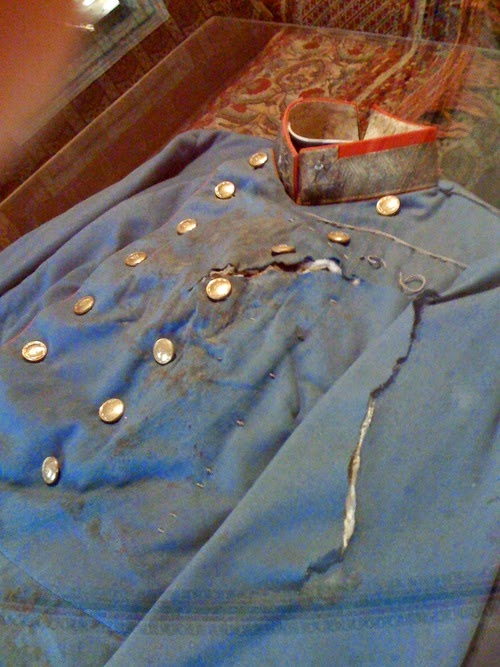
 Austria and its ever changing collection of satellite nations had been ruled by the Hapsburg Dynasty ever since 1279.    The Hapsburg Army's summer maneuvers in 1914 were held in Bosnia, a former Muslim province of Serbia that had been occupied by Austria in 1878 and annexed in 1908 . Archduke Franz Ferdinand was the nephew of the emperor, the heir apparent, and the Inspector General of the army. He arrived in Bosnia on June 25, 1914 to supervise and once the maneuvers were over, he and his wife drove to the capital, Sarajevo, for some official engagements. The Archduke really could not have chosen a worse time to visit Bosnia. June 28th, the next day, was the anniversary of the defeat of Serbia by the Turks in 1389. To the Bosniaks, it must have been like they had thrown off one oppressor only to gain another. His Excellency was warned that his visit was not welcome and could be dangerous, but he proceeded anyway. A murder team lay in wait for him, consisting of five young Serbs and a Bosnian Muslim. On the way to the governor's residence, one of the conspirators threw a bomb at the Archduke's car. It bounced off and exploded under the car, injuring another occupant. Forty-five minutes later, the Archduke and his wife were on the way to the hospital to visit the casualty of the previous attack when the chauffeur took a wrong turn and came to a stop while turning the car around.  This brought them in range of another conspirator who stepped forward and fired a pistol at them. The Archduke's wife Sophie (a woman he had all but given up the throne to marry, out of love) died instantly, the Archduke himself expired ten minutes later. The assasin, Gavrilo Princip, was arrested on the spot.

  The dying words of Franz Ferdinand were "Sophie, Sophie,don't die! Stay alive for our children. Sophie was an impoverished Czech aristocrat, considered unworthy of her husband by the rest of the powerful Hapsburg family. Archduke Ferdinand knew that his beloved wife would not be allowed burial in the Hapsburg crypt in Vienna, therefore, according to his earlier directions, he was buried beside Sophie at Arsetten Castle in Austria.

This assassination started a chain of events that would result in a shocking war that surprised everyone, but everyone wanted at the same time. I will cover the events of that fateful summer in the days to come. Today is to remember the man and his wife whose deaths ended the world.


Archduke Franz Ferdinand's Uniform
  

Thursday, May 29, 2014

The White Warfare

"To
My Comrades
Who fell in the White Warfare 
Of the South and on the
Red fields of France
and Flanders"
Sir Ernest Shackleton, C.V.O


    While Western Civilization was facing the beginning of the end in the summer of 1914, another noteworthy event was also well on its way. Sir Ernest Shackleton, that seasoned Arctic explorer was, with fifty-six other men, about to head south to be the first people to cross the Antarctic Continent. 
    The turn of the 20th century was the Heroic Age, when man's drive to explore every inch of his world peaked, and men sought that last, almost forbidden frontier, the poles. Literally, the very ends of the earth. Many countries were involved in the race to see who would be the first to reach the north and south poles, much like America and the Soviet Union racing for the moon some 60 years later. America won the race to the North Pole in 1909, Britain, an empire in decline, lost the race South to Norway in 1911. 
   Shackleton, a qualified master mariner,  had an abiding love for the cold, extreme edges of our world and was a veteran of polar exploration. He had been a part of Robert Falcon Scott's 1901 to 1903 Antarctic expedition. From 1907 to 1909 he led his own expedition to reach the South Pole, known as the Nimrod Expedition.  Their ship , the Nimrod, made it to within 97 miles of the pole when it got stuck in pack ice and had to turn back.  At that time, it was the furthest south anyone had been and Shackleton was knighted for his efforts. 
   Having lost the race to the Norwegians, Shackleton then devised the last great explorer's quest, to traverse the continent of Antarctica in its entire. Charting, exploring, and crossing the whole continent on foot was indeed nothing anyone had ever tried before. Years in planning the expedition was to be in two parts. One part, in the ship Endurance was to disembark at the Weddell Sea* and head for the pole, taking magnetic and meteorological observations, geological survey, and samples of Antarctic flora and fauna. The other part was to bring another ship, the Aurora,  to the Ross Sea, on the opposite side of Antarctica.  Their party was to go about halfway to the pole from their side and wait for the Endurance party  to meet them, also taking scientific observations. 
  The Endurance set sail August 1, 1914, but she almost never left at all. Once she was fitted out and ready to go, she was to be inspected by His Majesty King George V on the Monday of Cowes Week before setting sail. Cowes week was and still is the conclusion of the Season.  Let me pause and explain the Season. The Season is the social calendar of the elite in England and was also for a time in America. It began in the 17th and 18th centuries and was at its peak in the 19th.  At this time the aristocrats and landed gentry would leave their country houses and come to London to socialize and engage in politics, as it coincided with the seating of Parliament every year. This was also when young ladies were presented to society (and often to the Royal Court) and expected to find a husband as soon as possible. Once the Season was over, everyone would return to their country houses at the beginning of hunting season to shoot birds in Autumn and hunt foxes in Winter. 
   When Jane Austen was writing about Mr. Fitzwiliam Darcy and Miss Marianne Dashwood, the season ran from sometime after Christmas until the end of June. By the late  Victorian Era, the Season was standardized as running from April to August. After the end of the Great War, the Season fell into decline because many great families had to give up their London mansions. The Season is still preserved to this day, but the venues such as the Proms, the Chelsea Flower Show, Wimbledon, and so on are now more public venues. However, most events have a dress code where men and women are often required to dress in a more traditional way that resembles their Edwardian predecessors. It is a desiccated mummy, a last relic of a time gone by. 
Where was I? Ah yes Cowes Week. Cowes week is one of the largest sailboat races in the world, takes place the first week of August, and is one of the last events of the Season.  Cowes week in 1914 was the last real Season before the world blew apart. The Friday before that Monday Shackleton received a message saying the King would not be able to go to Cowes. The date was July 31, Archduke Ferdinand had been assassinated a month prior, and Austria was at war with Serbia.  Germany was threatening to attack France,  and Britain had just warned Germany that if they declared war on France, Britain would declare war on Germany. This last summer, this last Season before the world was turned on its head, was about to see off the last explorers of their kind. 
      Endurance left London Saturday August 1, but stayed anchored off the coast through Sunday, anticipating to be called up for war. Shackleton sent a telegram to the Admiralty offering to cancel his expedition and put himself and his men at the service of the crown. The Admiralty replied simply "Proceed."  Two hours later, Mr. Winston Churchill sent a longer telegram to Shackleton, thanking him and his party for their offer and stating the authorities desired the expedition to continue as planned. Tuesday, August 4th, the King did arrive and gave Shackleton the Union Jack to carry on the expedition. War finally erupted at midnight on that same day. 
    Shackleton took a lot of criticism later on for leaving when he did, without consulting the donors of the expedition. But the Admiralty had told him to continue as planned, and no one expected the war to last more than a few months. Indeed most expected it to be over by Christmas. This tiny capsule of the preserved Edwardian world was about to leave the civilized world to its own un-civilizing, and undergo a conflict against the elements of nature that was no less dangerous or strenuous than men shooting bullets and driving tanks at each other back home. They made it to Buenos Aires, Argentina on October 26, and from there sailed to South Georgia, a small island south of the Falklands which was the southernmost outpost of the British Empire, and indeed the very edge of civilization itself. From there was the unknown. 


* The land and sea area from the Falkland Islands extending to the South Pole was considered British territory at this time.