Wednesday, June 10, 2015

Winter's Embrace: March to August 1915

   And now there came both mist and snow,
And it grew wondrous cold:
And ice, mast-high, came floating by,
as green as emerald

And through the drifts the snowy clifts
Did send a dismal sheen:
Nor shapes of men nor beasts we ken-
The ice was all between

The ice was here, the ice was there,
The ice was all around:
It cracked and growled, and roared and howled
Like noises in a swound!
~Samuel Taylor Coleridge, The Rime of the Ancient Mariner


March 1915 began with a severe northeasterly gale.  During the gale, which lasted until the 3rd,  all hands spent the time clearing out the 'tween decks to convert it into a living and dining room for the officers and scientists.  In this room, the carpenter installed the stove that was intended for the shore hut, but since the ship was not currently headed toward shore, it was put to use here. The dogs did not seem too bothered by the weather, although one of the older dogs died of appendicitis the night of the 2nd.
   When the weather cleared, it was found that the ice had been driven in from the northeast and was now packed more closely together and a new iceberg, possibly fifteen miles in length, had appeared on the northern horizon.  By this time, many of the bergs that surrounded them had become familiar sights and some even had names. The bergs had appeared to be drifting with the pack, so the appearance of a new one was of great interest.  In such a shallow sea, a berg of that size could easily be stranded and exert pressure on the surrounding floes.  The population of Endurance had already seen the results of an encounter between a berg and a floe, and had no wish for their ship to experience the same.
     The scientists were very busy at this time.  Meteorologist Leonard Hussey was able to set up his recording station containing anemometer, barograph (a contraption rather like a seismograph for barometric pressure), and thermograph (same thing, but for temperature).  The geologist, James Wordie, was unhappy as they were still at sea and not on land, but contented himself with pebbles found in the digestive systems of penguins and rocks brought up from the sea floor. Robert Clark, the biologist, frequently used the dragnet to haul up plankton for study.
   Seal meat made up most of their diet this time, as the company was trying to preserve their food supplies.  Seal meat is apparently very tasty, and the men would have been happy to eat nothing but it, although they discovered that crab eater seal was preferable to Weddel seal.  Although many of the larger whales had gone north, the Killer Whales were still with them, and one day they found slabs of ice 3 feet thick pushed upwards where a Killer Whale had been smashing ice for a breathing hole.
   The new quarters in the 'tween decks were complete on the 10th and became known as "the Ritz". Meals were now served there, instead of the ward room, breakfast was at 9 a.m., lunch at 1 p.m., tea at 4p.m. and dinner at 6 p.m.  By the middle of the month, all hands were settled into winter routine.     The next day, the 11th, Captain Frank Worsley, Photographer Frank Hurley, and Wordie set out for one of the large icebergs, which had been designated Rampart Berg, about 7 1/2 miles distant.  In all, they covered a distance of about 17 miles. Hurley took photographs, and Wordie was delighted to find dust and some moss.  Worsley reported that the ice around the berg for about one mile was strong enough to march upon, and the dangerous pressure of the floes around the berg did not extend more than a quarter mile.  This was useful information considering if the iceberg was instead a ship, their ship, it would be important to know how much pressure they would handle. On the 14th, land was faintly visible to the Southeast, about 36 miles out.  A few leads of open water could be seen from the ship, but the ice was still firmly packed in the immediate neighborhood. The drift of Endurance with the pack was still northwest.
   Shackleton had been burning two hundredweights (in Britain a Hundredweight is 112 pounds, so about 224 lbs.) a day to keep the boilers from freezing.  This practice ceased on March 15th. They still had about 52 tons of coal left, but at that rate, there would not be much coal left for steaming by spring. Although, Shackleton also planned to supplement their supply with seal and penguin blubber.
   Fine snow fell on the 17th, but then the weather cleared to reveal a beautiful sunset and a famous occurrence at the ends of the world, the Fata Morgana, a type of mirage.  Fata Morgana comes from the Italian name of Morgan(a) le Fay, the sorceress of Arthurian legend, as it was originally believed the flickering image above the horizon were fairy castles or false land created by witchcraft.  The scientific explanation is a bit more mundane, Fata Morgana occurs in calm weather and  is caused by a thermal inversion, when a clearly defined layer of warm air rests above a layer of cooler air. The upper-level warm air acts like a refracting lens and bends light rays to make distant objects, even those over the horizon, visible.  The actual thing itself is far from mundane, with fantastic distorted images of cliffs, ships, or buildings shimmering and ever-changing, often upside-down and even with several inverted and right-side-up images stacked on top of each other in the sky. Shackleton reports images of distant ice cliffs were seen in the sky in double and triple parallel lines, some of them inverted. He states this was probably due to open water near land causing the mirage.
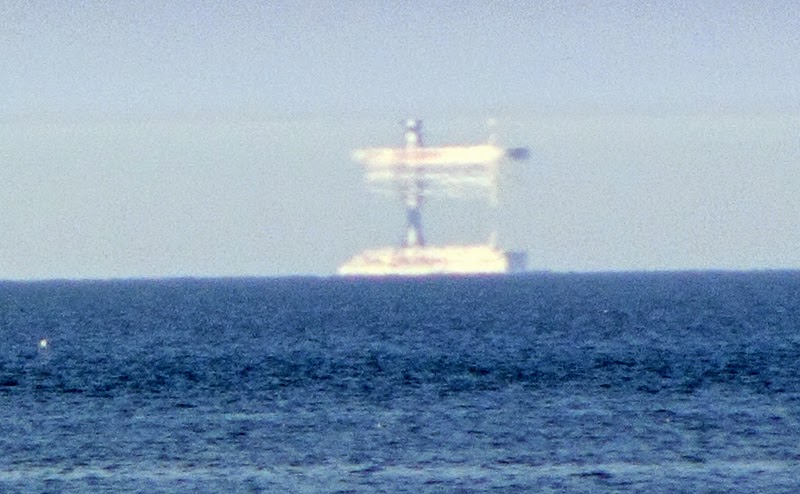
Fata Morgana of a ship
   Mirages were a frequent occurrence in calm weather. On March 29th, barrier cliffs appeared all around the ship, even in places where they knew was deep water.  Shackleton wrote, "Bergs and pack are thrown up in the sky and distorted into the most fantastic shapes.  They climb, trembling, upwards, spreading out into long lines at different levels, then contract and fall down, leaving nothing but an uncertain, wavering smudge which comes and goes. Presently the smudge swells and grows, taking shape until it presents the perfect inverted reflection of a berg on the horizon, the shadow hovering over the substance.  More smudges appear at different points on the horizon.  These spread out into long lines till they meet and are girdled by lines of shining snow cliffs, laved at their bases by waters of illusion in which they appear to be faithfully reflected.  So the shadows come and go silently, melting away finally as the sun declines to the west...."
   Building winter quarters and gazing at mirages was not the only thing to be done.  The men began serious training for the dogs to pull the sleds, although they lost some dogs to stomach and intestinal worms.  The scientists continued to dredge the sea bottom for specimens. In addition to mud, they brought up rock fragments, pebbles, sponges, worms, brachiopods, and foraminiferae, a type of protozoa. One of their best hauls yielded a 75 lb lump of sandstone, a piece of fossiliferous limestone, a fragment of striated shale, sandstone grit, and some pebbles. On one occasion, they heard a great yell from Clark and witnessed him dancing about shouting Scottish war cries. He had apparently just secured his first complete specimen of a new species of Antarctic fish. (Ah, nerds.)
    From January 19, when the ship got stuck, until March 31, the pack had drifted 95 miles in a North 80 degrees West direction. The icebergs had not changed their relative position the entire time. As March moved into April, the sun sank lower in the sky and the temperature gradually dropped.  The surrounding ice began to thicken, and very little open water was to be seen.  They tried to get a wireless signal the morning of April 1, but again failed. Soundings of the sea floor indicated the sea was continuing to shoal, and gravel in the bottoms samples indicated they were nearing land.
    April was not without event. During the night on the 3rd, they heard ice grinding to the east, and in the morning saw ice that was rafted by pressure to a height of 8-10 feet.  The next day brought the prelude to what the ship would later face, ice was heard grinding and creaking and the ship vibrated slightly.  Shackleton gave orders that all the ice, snow, and debris which had accumulated around the Endurance should be shoveled away.  In case pressure increased, he wanted no extra weight on the ship to prevent it rising above the ice.  On the evening of the 15th an interesting phenomenon was observed. The sun set on a line of clouds just above the horizon.  A minute later Captain Worsley saw a golden glow, and then the sun reappeared above the horizon.  A quarter of an hour later, the sun set a second time. Of course, it was not the real sun, this was a type of mirage, which they attributed to an ice crack to the west, where a band of open water had heated the air.
    The sun set for the final time on May 1, so began the long twilight that would give way to the darkness of winter. On that day, the sun just cleared the horizon at noon, and set just before 2 p.m.  The company of Endurance, however, refused to lose their customary cheerfulness. Still, Shackleton knew the ice would not permit them to return to Vashel bay.  Although there were a few good landing spots on the western coast of the Weddell Sea, he was not sure they could be reached early enough in the coming year to make a journey over land possible.
   May dragged into June with little noteworthy event.  Whatever may come, the training and managing of the dogs was essential, and that took much of their time.  On June 15 they held the "Antarctic Derby" a race of sled teams.  Betting was heavy, wagers were placed with everything from money to chocolate and cigarettes. Five teams drove the 700-yard course, and the winner was Frank Wild's team, which ran the distance in 2 min. 16 seconds, or about 10 miles per hour.  Midwinter's Day was celebrated on the 22nd of June, with a twilight of about 6 hours and good light from the moon. Only necessary work was done, and after dinner, all hands gathered in the Ritz for speeches, songs, and toasts until midnight, when they sang "God Save the King."
    Beautiful sunrise glows in the early days of July heralded the return of the sun, which were soon followed, on the evening of the 13th, by the most severe blizzard they had experienced in Antarctica. During the blizzard the temperature ranged from - 21 to- 35 degrees F.  Temperature often rises during a blizzard, caused by warm foehn winds flowing down a mountain range.  The temperature did not rize in this blizzard, indicating there was no high land for at least 200 miles to the south.  Ice pressure was an increasing cause of anxiety.  Ice was rafting 10 to 15 feet high and cracks were opening everywhere while the ship was jarred with heavy bumps.  After seventy-nine days of darkness, the sun re-appeared above the horizon on July 26. Biologist Clark was happy because the returning light made diatoms return to the ice, as they cannot multiply without light.
    One year to the day since Endurance left England, Sunday August 1 1915, the ice that held the ship fast broke up suddenly.  All the dogs and sleds were brought aboard safely, but the ship presently listed to port against the currently blowing gale, and was forced forward at the same time. But as quickly as it happened, the sea subsided again, although the party was alarmed, and orders were given for all hands to stand by. In the breakup, a large lump of ice was wedged between the rudder and the stern post.  Although the men were able to pole the ice away, damage had been done.  Closer examination revealed the rudder had been pushed hard over to starboard and the blade partially torn away from the rudder head. The ice pack was still in chaos, with floes rafting and banging into each other, so repairs could not be effected.
   Four dogs had to be shot on August 3.  They were suffering horribly from worms and the party could not afford to keep sick dogs under such chaotic conditions.  The ice gradually settled down, until there was no open water to be seen nearby and no land could be viewed for 10 miles. The next day dog kennels were built on deck, and the sun was seen above the horizon for nearly an hour. Despite the upheaval of the ice,  nearly all the ice bergs within view stayed in the same position that they had been for the past seven months.
  By August 24, no land could be seen from the masthead within 20 miles. A sounding of 1900 fathoms the next day further proved the nonexistence of New South Greenland.  New South Greenland, also known as Morrell's Land, was supposedly sighted in 1828 by Captain Benjamin Morrell of the Wasp on a voyage in the Weddell Sea.  Morrell gave precise coordinates and a description of the coastline, which included mountains, and claimed to sail along the coast of this land for over 300 miles.  The problem was, no one who came after him could find land in that area.  And now that Endurance  was in that area and found no land whatsoever and very deep sea, New South Grenland obviously did not exist.  Still, Captain Morrell saw something, what was it?  It is suggested he saw a very large ice berg, (although even the biggest are not 300 miles long), he could have been mistaken as to where he was in the Weddel Sea and actually sighted the "Foyn Coast", which is part of the Antarctic Peninsula and about 14 degrees further west than New South Greenland was presumed to be. Or, most likely, Morrell was taken in by yet another Fata Morgana, the constant companions of polar explorers that reflect flat coastline in the sky to appear as tall cliffs.
Fata Morgana of nearby land

Iceberg in the vicinity of "New South Greenland" taken from Endurance, August 1915
   Late at night on the last day of August, the ice began to squeeze the ship again, cracking and groaning noises, along with occasional buckling of beams and planks continued through the next day. The day after that, September 2, a large sheet of ice was gripping the port bow about three feet beneath the water's surface.  Shackleton had hoped they would not have to march across ice to reach the land but, although Endurance was a strong ship, even the strongest ship could not withstand the deadly embrace of ice forever.

Thursday, May 21, 2015

A Nineteen Year Pilgrimage: Saluda, South Carolina

In some good cause, not in mine own,
To perish, wept for, honor'd, known,
And like a warrior overthrown.
~J. Hampton Kuykendall Sketches of Early Texians

      February 1996 saw my first of several visits to a place that would soon define part of my life, I trod hallowed  ground and visited the Alamo in San Antonio, Texas.  Very soon after, the story of that place and of all the great heroes that gave their lives there would capture my heart, and launch me into a journey that continues to this day.  I sought and still seek to learn as much as I could, and become intimately familiar with the lives of these men, the causes leading up to the siege, those fateful 13 days and what followed after.  Although not the sole reason, the Alamo is part of why I became an historian.
    I left Texas several years later, and beautiful San Antonio with her, but the Alamo I carried with me, or maybe a piece of me stayed there. It became a fortification against howling modernity, and a reminder to always be courageous.  Years passed and and I wended my way through Colorado (leaving myself there as well), Florida, and eventually to South Carolina.
  South Carolina! From its original refusal to approve the U. S. Constitution, to the Nullification Crisis, to the Secession itself, South Carolina is one of the most fractious states of the Union.  It is little wonder that such a place would produce two firebrands in  the form of William Barrett Travis and James Butler Bonham.  Of all the heroes of the Alamo, these two are the most dear to me. And when I found myself in the state of their birth, I knew I had to find the place where they stood.
   While still in college, I discovered that both were born on a fairly-civilized frontier near a town in 1809 as Red Bank, but was later renamed Saluda when Saluda County was created from the Edgefield District. I do not remember the exact year, but I believe I was yet in school when I also discovered that the house where James Bonham was born, known as Flat Grove, still stood.  It is only surviving birthplace of an Alamo hero.  When I discovered this place was extant, I vowed to see it for myself.
   Life got in the way for a while, Saluda isn't exactly near any large cities or major interstates so you can't visit it on the way to somewhere else. And Flat Grove is in a rather obscure place, only to be seen by appointment.  When I got around to being able to go, I found out the historical society had closed the house to visitors, and I all but gave up being able to see it ever.  Finally, early December of last year, I was browsing the internet and found that the Saluda County Historical Society had reopened the house after repairing it and partially furnishing it.  After the turn of the new year I determined now was the time.  I called the Historical Society and made an appointment.
   April 11, 2015 finally arrived.  Saluda, by the way, is South of Greenwood and Newberry, and almost due west from Columbia. We pulled into town a little early for our appointment, but there was an interesting looking monument in front of the courthouse.  We wandered over to it through the morning-damp grass, and I was presented with this.


  I didn't expect this,  and was speechless with awe.  This little out-of-the-way town held more esteem for these two than I realized.  I would later learn from the museum curator that James Butler Bonham and William Barrett Travis were inducted into the South Carolina Hall of fame in 2001.  Usually each year a living and a dead South Carolinian are inducted, but since Travis and Bonham were from the same place and died together at the Alamo, an exception was made and two deceased native sons were added to the rolls.
   The museum was wonderful,  I would have stayed there all day if I could have, as it contains everything anyone ever wanted to know about the history of the city and county of Saluda.  Plus, whole section dedicated to the Alamo, complete with artwork and an extraordinary diorama with hand-painted figures. All of the museum volunteers and society members have much love for their work, it was obvious.  Still, tempus fugit and I had to tear myself away from the museum to see the goal of my quest.
     Flat Grove is, as I said,  not easy to find without help.  Our two guides were marvelous.  The house originally was build in the flat lowlands along Richland Creek (hence the name Flat Grove). For preservation purposes, it has since been moved about a mile and a half back from the river, on a slight rise. Built by Jacob Smith in the early 1770s, the house has only belonged to two families:The Smith/Bonham family sold the house to Henry Conrad Herlong in 1856.  The Herlong/Boyd/Matthews family deeded it to the Historical Society in 1989.  I suspect the land that the house sits on belongs to the second owners since two roads that lead to the house are named Herlong and Boyd's Branch.  When the house had been deeded to the Historical Society, two rooms had already fallen to the ground, and the house was declared not salvageable.  But Bonhams don't admit defeat so easily.  Flat Grove was taken apart piece by piece, transported and lovingly reassembled where it now stands.
   When I saw the house, it took my breath away, the quest had been fulfilled.
 "Come down, come down sweet reverence, unto my simple house and ring". ~Gregory Alan Isakov The Stable Song
  Though it doesn't look like much now, it was a mansion in its day.  The house was originally built in a "dog-trot" style (one room on each side with a breezeway in the middle), then the breezeway was later enclosed, two more rooms built behind, and two rooms above.  Finally, in the early 1900s a kitchen and porch were added to the very back of the house. The exterior has never been painted, and many of the interior rooms still have the original blue-tinted paint, probably made with indigo. (Indigo and rice were the major cash-crops of the low-country plantations).

Entrance hall (former dog-trot) of Flat Grove, note the blue paint

One of the two front rooms, the oldest part of the house. Do you think James B. Bonham stood on these floorboards? 

The original stair case was enclosed when the newer one was built, but still functional. Dad added for perspective.
One of the rooms built behind the original rooms. The bed belonged to the last family to own the house. Also more indigo paint. 

Fireplace in one of the upstairs rooms. 
       Like the museum, I could have spent all day at Flat Grove. But, while at the museum, the curator had mentioned a Travis Monument. Of course, this I had to see, so we climbed back into cars and followed our worthy guides down the road.  True enough, at the junction of Highway 121 and Rocky Creek Road sits this, front and back.


   Across the road from this monument is land that was the original Travis homestead.  The land is privately owned, so no public access is allowed, but I there are unmarked graves not far from the road that are presumed to be Travis family members, including William Travis' grandparents, Berwick and Ann Travis.
  By this time I decided I might as well take the grand tour, so we went on a short distance down the road to the Marsh-Johnson house.  While not associated with the Bonham or Travis families, this house is one of the oldest in the area and was at one time a plantation house and tavern. It sits  at the corner of Rocky Creek and Fruit Hill roads, along one of the earliest roads through the region. Usually the term "plantation house" conjures mental images of 50 roomed, white columned mansions right out of Gone With the Wind, but most of them were probably much like this.
The Marsh-Johnson house, with anachronistic security system, which doesn't keep squirrels out.

     Marsh-Johnson is smaller than Flat Grove, and about 40 years younger.  It was built sometime between 1804, when the land was sold to Bryan Marsh, and 1825 when the house appears on a map of the area. It has been restored and is in very good condition, despite the persistent squirrel problem. There are six rooms total, a large front room, a smaller parlor to the side, Two large rooms upstairs, and then the back porch was later enclosed to make another room and a kitchen,  Except for upstairs, this house is fully furnished, and has electricity.
    Like Flat Grove, the interior walls are painted a blue, probably with the same type of indigo dye. The stairs, while still unwieldy in the dark, are better built than the original staircase at Flat Grove.
The front room of Marsh-Johnson

The parlor to the side of the main room, decorated as a Ladies' Parlor

The back bedroom

One of the two large rooms upstairs.  I'm not sure I'd be keen on staying up here with half  a dozen or so strangers.

The kitchen, added later by enclosing the back porch and decorated 1940s style
   The twin chimneys of Marsh-Johnson are quite interesting.  The pattern is called a Flemish Bond and is made by alternating headers (the short end) and strechers (the long end) of the bricks.  This actually makes for a stronger structure than just using the long sides of the bricks.  The headers are glazed with a blue glaze that is still apparent.  Such glazing and the Flemish Bond pattern indicate this house was built for a person of some wealth.


Blue glaze of the brick headers

   So that was Saluda.  I took my leave of the houses, the land and the charming and helpful museum staff. Once I returned home, it was in the following days that I realized I had left part of myself behind again. I had left a piece of myself beneath the floorboards of one of the most beautiful houses I had ever seen (not for its looks, but for who came from it), and another piece in a spring-greening field that likely held the bones of a once indentured servant whose grandson would sign "Victory or Death" to a plea for help in defeating a tyrant, and thereby send himself an another 180 odd men and women into Apotheosis. The story of the Alamo is the story of South Carolina and America as a whole, as much as it is the story of Texas. For the first time in 13 years, I feel like I am home.

   I would also like to give my sincere thanks to all the volunteers at the Saluda County Historical Society.  They were informative, helpful and very accommodating.  If they ever see this, I hope they know how appreciated they are.  

Saturday, March 21, 2015

The Infidel Pages: Kiss me, I saved Western Civilization

  To go to Rome
Is little profit, endless pain;
The master that you seek in Rome,
You find a home or seek in vain.
~ Early Irish Christian Proverb


  Saint Patrick's day in the present time has become something of a parody, one would even tempt the term mockery of its original significance.  Today we wear garish costumes, march in chintzy parades, get raving drunk, and dye rivers green to celebrate the conversion of the Irish pagans to Christianity.  "Everyone's Irish on Saint Patrick's Day!" "Kiss me, I'm Irish!" I often wonder what the point is of all this display.  Other than, like Cinco De Mayo, yet another excuse to get drunk. Somewhere in all the kitsch is the point of the holiday, to celebrate the Irish people's conversion to Christianity.  Why is this important? Because if a bunch of barely literate pagans had not come to Christ and taught themselves to read and write, Western Civilization might have been lost.
   Let us back up to the so-called "Fall of Rome" really more of a Subsidence of Rome or The Same Rome under New Management.  I say this for two reasons.  One, Rome did not fall as say, Carthage or Babylon fell.  Those civilizations were destroyed outright, Rome was not.  Yes, some "barbarians" sacked the city of Rome a few times, mostly because they wanted what Rome had and I don't just mean money. They wanted the technology and the culture too. The Visigoths caused the Sack of Rome (the most famous one that caused St. Augustine to write his "City of God") on August 24, A.D. 410.  After that, Rome formed a partnership with these Germanic peoples, who would later help them fight of Attila the Hun. The Vandals and Ostrogoths would come later and, with the help of the Visigoths, would completely take over the City and put Rome under new management, i.e themselves. By then, the seat of the Roman Empire had already been moved to Constantinople as of A.D. 333.  So the Roman Empire proper did not fall until Constantinople was taken by Muslim Turks in 1453. Sultan Mehmed II, who took over the city once conquered, also referred to himself as "Caesar of Rome". Side note: The German title "Kaiser" which is what Germans called their kings until Germany didn't have kings anymore is the German word for "Caesar" as is the Russian title "Tsar".
  Friends, I must pause here a moment.  I received a minor epiphany a few weeks ago and intend to explore it further with you.  I was presented with the theory that German Barbarians did not cause the Fall of Rome. Neither did wantonness or Christianity or something strange in the water that made everyone suddenly stupid, but by Islam. Islam took out Rome and almost took away Western Civilization entirely.  This certainly makes more sense than most of the other theories posited over the past 1400 years, and I have no reason to doubt the information. But I do need to investigate further.  I am starting a new column in this blog about Islam and its 1400 year war on Western Civilization. This is the first installment.
   Back to Ireland.  Meanwhile, up north there's an island that the Romans called Hibernia. It would later be called Ireland.  They didn't really bother much with it, Britannia itself was almost too much for them to handle (see: Hadrian's Wall).  Hibernia was peopled with unshaven, unwashed, savages. Rome left them alone and when they moved out of Britannia, due to trouble back home, the Romanized Celtic peoples they left behind were at the mercy of said savages. These Scotti, as they were known, liked to raid the coasts of Britain and take slaves. A sixteen year-old boy named Patricius was one of these. Patricius, raised in the civilization and comfort of Roman Britain, found himself a slave, a sheep herder to his barbarian master in Hibernia. The man who would become known as Patrick was a man of few words, and doesn't tell us much about his early life, save that he spent six years hungry and cold tending sheep. He only found consolation in one thing, God. Patrick would pray night and day, that was his only consolation.  One day a vision prompted him to escape.
    He eventually made his way home, to Britain, but he did not stay. Patrick could not get his former masters out of his mind. Another vision prompted him to be ordained as a priest and bishop, and then head back to Ireland to bring the love of Christ to the dark world he had once escaped. That one spark of light would catch the whole island on fire.  In the thirty years from Patrick's return until his death in A.D. 461, Ireland was transformed from a completely pagan to a wholly Christian land.  The Irish have never done anything halfway, and their new found faith was no exception.  They made literacy the central act of their new religion.  In a land that was previously illiterate and in darkness, the written word now became their light.  With civilization crumbling to the south, these monks took every book and manuscript they could find, many of them brought back from pilgrimages to Rome. Hebrew scripture, Greek commentary, Greek and Roman classics, Church fathers, their own myths and legends and preserved them.  Everything they found was copied, re-copied, translated, copied again. They even invented languages and wrote in those.  As their ancestors would collect the heads of their enemies as trophies, now they collected books.
     And it did not stop there, the Irish now had to share their new found faith with the world.  Among the first was one Columba, who crossed the sea to former Britannia, now taken over by the Anglo-Saxons, and began to teach them about Christ, and how to read. The rest would fan out across Europe, shining light into the fast-darkening world. Charlemagne, who himself could barely write his name, gathered a whole group of Irish monks to educate his children. Many of these Irish missionaries would go on to found monasteries that would later become cities: Liege, Salzburg, Vienna, and Rheinhau.  When the Vikings arrived in Iceland in A.D. 870, they found Irish monks. Whether or not they made it all the way to North America is still in debate, but it is possible.
    Where they went is less important than what they did.  Wherever they went, these Irish brought their books, everything that had been salvaged from the collapsing culture that was Rome.  Had they not...well I won't say Western Civilization would have completely disappeared, it probably would have restarted itself somehow.  But undoubtedly it would have taken much, much longer.


Saturday, February 21, 2015

Belgium Says "Over My Dead Body!" Germany Takes it Literally.

 The minstrel boy to the war is gone,
In the ranks of death you'll find him;
His father's sword he has girded on,
And his wild harp slung behind him;
"Land of Song!" said the warrior bard, 
"Though all the world betrays thee,
One sword, at least, thy rights shall guard,
One faithful harp shall praise thee.
~Thomas Moore, after 1798

While the statesmen of Europe greeted the onset of war with foreboding, the general public were wildly enthusiastic. When war was announced, crowds thronged the streets cheering and singing patriotic songs. In Russia, a huge crowd assembled in the Winter Palace Square of St. Petersburg, carrying icons, flags, banners and portraits of the Tsar. When the emperor appeared on the balcony, the crowd knelt and sang the Russian national anthem.  A similar gathering was held in Munich where the mobilization proclamation was read. In the Berlin Cathedral, the Kaiser's pastor led a huge congregation in the recitation of Psalm 130 (I am not sure what that particular psalm has to do with war...I suppose it would make more sense if I were German.) and at the Oranienstrasse Synagogue the rabbi conducted prayers for victory.
   The holiday atmosphere was carried on by the men being sent out.  French soldiers would compare what mobilization days they were assigned as if they were comparing sports scores. "I am the on the first!" one would say 'beat that' being implied. "I am the ninth" another would respond, and the others would reply "Rotten luck for you, you will miss all the fun. The War will be nearly over by then." The unlucky ones were assigned the later days if mobilization.  "You'll never make it to Berlin in time!" the others would say to him. No matter what day they were to leave, they were all put on trains and sent to preparation points just behind the frontier, usually at stations in small villages whose huge train platforms had been designed just for such a purpose .
   French and British soldiers had a relatively short journey to war. The French headed northeastward to the Frontier, while the British arrived at Boulogne on August 14 from their ships and headed south to Le Cateau, close to the Belgian border. Germany, by contrast, had a longer race, west, and then south towards Chalons, Epernay, Compiegne, Abbeville, and finally they intended to take Paris. From their detraining points at Aachen, on the western border of Germany, to Paris was 200 miles.  But before Paris, the Germans would have to go through the Belgian fortresses, Liege, Namur and the others that surrounded Belgium to keep foes out.  Disproportionately wealthy (for its size) thanks to an early industrial revolution and goods that poured in from it's colony in the Congo, Belgium had invested heavily in fortification to defend its neutrality.  As a result, Belgium had the most modern fortifications in Europe. Built between 1888 and 1892, they were designed to withstand the heaviest gun then in existence, the 210 mm (8.4 inch). Each defense consisted of a circle, 25 miles in circumference, of individual forts arranged in a circle to protect the city they defended and lend each other the service of their own guns.  A garrison of  40,000 men were used not just to operate the guns, but at threat of invasion, dig trenches between the forts to close all gaps and hold the enemy at bay.
    Back in Schlieffen's day, Germany wasn't really sure how they were going to get through Belgium, no gun existed that would pierce the concrete and steel of their forts. In 1909, the answer came in the form of a 420 mm (16.8 inch) howitzer. The only problem was this gun was almost too big to move, it had to be transported by rail and embedded in a specially built concrete platform for action.  Austria developed a much more manageable 305 mm (12.2 inch) gun the next year.  Nearly as powerful and far more portable.
    If Germany wanted to get anywhere outside its own borders in this war, Belgium had to be taken. General Otto von Emmich was given 48 hours to overtake the country.  The Germans expected Belgium would either not resist at all, or if it did,would be quickly subdued. They were wrong. The Belgian constitution made the king commander-in-chief during war, and also president of his own council of ministers. King Albert I was not one to take such a responsibility lightly.
 At this time, if one had looked from above, they would have seen the French Army aligned towards Lorraine, the German army whose main force had still not left Germany, the British Army still mobilizing, Belgium's army concentrated in the middle of it's homeland and, a small German strike force pinned down by a small group of Belgian fortress troops determined not to let them in    Belgium had international guarantees of its independence and neutrality, which it took very seriously. In 1912, Britain had politely offered to lend assistance in the event Germany invaded, Belgium refused.  Diplomatic delicacy kept France from making a similar offer.  In their refusal of help, the Belgian government was aware it would have to stand on it's own when Germany came.
   Stand they did.  When Germany delivered its ultimatum, King Alfred refused the terms and also refused to ask Britain and France for help.  Kaiser Wilhelm was a distant relative of Alfred (along with every other royal family in Europe) and he politely entreated Cousin Alfred saying that it was necessary for Germany to come through  Belgium to get to France if Belgium were only so kind to let them through. "What does he take me for?" was Alfred's response, and he gave orders to destroy the bridges leading into Belgian territory. The man in charge of holding off Germany was General Gerard Leman, a 30- year veteran of the War College and the king's former military tutor. Leman was a man of hono rand courage, with an unyielding sense of duty.  Alfred told him to hold the fort at Liege to the end.
    The Meuse River, at the border of Belgium, enters a 450 foot deep gorge as it flows past Liege, a natural moat not easily crossed in the face of opposition.  Emmich would learn this when he entered Belgium and made his way to Liege.  Emmich and his troops entered Belgium on August 4, and soon came under fire from Belgian cavalry and troops on bicycles that showed an unexpected resolve to keep the Germans at bay.
   Germany interpreted international law to mean that an occupying force shout treat any resistance as rebellion, and such resistance should be punished.  Belgium had been warned if they demolished their bridges, Germany would consider it a hostile act.  When the Germans got to Liege and found the bridges blown, they responded as threatened in what would be called the "Rape of Belgium". Innocent civilians were shot and villages burned, priests were even shot. Men, women, and children were massed in village squares and shot by execution squat, the survivors bayoneted.
   The worst was at Louvain, called the "Oxford of Belgium". This town was a treasure of Flemish Gothic and Renaissance Architecture, paintings, manuscripts, and books. The Germans, panicked by a nighttime movement of their own forces, began to shout "Snipers!" and set fire to streets and buildings where they supposed the offenders to be. After a three day inferno and looting, the library with 230,000 books was gone, along with 1,100 other buildings.  Two hundred nine civilians were dead and population of the town, 42,000 strong, evacuated.
  This slaughter served no real purpose and actually harmed the reputation of the German army and the German people, especially in the eyes of the United States.  Worldwide accusations of Germany's war on culture started immediately, which incensed the German citizens themselves. Their own academics represented the war as an attack by barbarians, decadents, and philistines (Russians, French, and British respectively) on high German civilization. Germany had always prided itself on being a major contributor to Enlightenment ideals of philosophy, science and classical scholarship. To be found out as book-burners was almost too much for them to bear.  I would wager that even some German citizens themselves were shocked the acts of their own fellow countrymen. (Just wait until the second time around, then you'll really burn some books.)
   On August, Captain Brinkman, military attache to Brussels, arrived at Liege to demand Leman's surrender.  He was turned away, and the German bombardment of the eastern forts began. The Belgians held their ground, and German casualties mounted throughout the night. The next morning, General Erich Ludendorff fought his way to a high point where he could look down into Liege itself. A force of 6,000 Germans had penetrated Leman's ring of forts, and Ludendorff ordered in a party under a flag of truce to demand a surrender.  The surrender party was told off, and a raiding party that followed them was shot down at the door of Leman's headquarters. Gerard Leman intended to stand as long as the forts remained intact, which they still did.
    Leman thought the forts were assaulted by five German corps, and therefore he sent the infantry, the 3rd Division and the 15th Brigade to join the field army outside Brussels for fear Belgium would be overrun.  He was mistaken, the Germans at the gate were merely representative of the five corps to which they belonged. But his miscalculation spared one-sixth of the Belgian army to fight in Antwerp, where King Albert had already planned to make his last stand.
   For a fleeting moment, the outcome of the conflict was unsure. Ludendorff had broken through the ring, but did not have sufficient force to demand a surrender as Emmich's forces remained outside. King Albert had appealed to France for help, but all they promised to do was send some cavalry troops to reconnoiter.  Britain had planned to deploy six divisions to Belgium, but now decided to keep two home.
    The spell was broken by Ludendorff. On the morning of August 7 he sent the 14th Brigade crashing through the center of Liege on the off-chance he would not be opposed. He was not. General Ludendorff marched up to the gates of the citadel and hammered on them with his sword, and was admitted.  The garrison surrendered the city to him...just like that.
  Emmich, meanwhile, was ravaging the other forts with some fancy new artillery.  The first Krupp 420, later known as the Big Bertha, arrived August 12 and was immediately put to work.  The crew lay prone 300 yards away with padding wrapped around their heads as the gun was fired electronically. The gun was loaded with delay fused 2,000 pound shells that would only explode once they had penetrated the fort. It didn't take long once elevation and range had been perfected. Pontisse was a wreck when it surrendered at 12:30 the next day. Embourg fell at 17:30, Chaudfontaine was destroyed when its magazine exploded. On August 14 Fort Liers fell at 09:40 and Fleron at 09:45. The day after, the 15th, Boncelle fell at 07:30, Lautin at 12:30.  Fort Loncin, where General Leman had headquartered nine days prior, was destroyed after 140 minutes of bombardment when it's magazine was penetrated. The final two forts Hollonge and Flemelle surrendered on the 16th without struggle
    A few forts in Belgium and around Europe would remain standing, but this war essentially ended the era of the fort in modern warfare. For thousands of years men were protected, and held off the enemy for months behind ramparts of stone and steel. But with giant guns that could blast their walls to rubble in hours, forts had become obsolete. Battles would now be fought by ramparts of men, rather than stone.
   Just such a rampart was being built to the South as Germany was tearing into Belgium. The French, thinking that Germany would come for them first, assembled along the common frontier they had with Luxembourg and Switzerland. Marshall Joseph Joffre ordered General Bonneau to take Mulhouse in Alsace, hoping to raise the countryside against the Germans. Their turn would come.  Once Germany had finished with Belgium, it would turn its eyes southeast to the ultimate prize, France.

Monday, January 19, 2015

Breaking News! Update on an Earlier Post


     On April 19, 2014, I wrote a little essay about a very great man: Zionist, Irishman, War Hero, Lion Killer and "godfather of the Israeli Army" Lieutenant-Colonel John Henry Patterson, D.S.O. That can be viewed here .When I wrote that that, Patterson and his wife, Francis Helena, had been cremated and interred at Angelus-Rosedale Cemetery in Los Angeles, CA.  According to Patterson's only living descendant, his grandson Alan, the Colonel wished for his and Francis' remains to be interred in Israel.  Mr. Alan Patterson, the Jewish American Society for Historic Preservation, Canadian Representative Todd Young, Beit HaGedidum, and the Moshav of Avihayil effort led by Ezekiel Sivak began working toward that end in 2010.
    Friends, I am happy to announce that this has now occurred!  With the assistance of Israeli Prime Minister Benjamin Netanyahu and the Israeli Government, Lt. Col. J.H. Patterson D.S.O and Francis Helena Patterson (nee Gray) were re-interred at the Avihayil cemetery on December 4, 2014.  They rest now with some of the men that Patterson himself commanded in the First World War. Attending the ceremony were Prime Minister Netanyahu, members of his family, military and cabinet ministers of the Israeli government, the British Ambassador, the Irish Ambassador, Alan Patterson, Jerry Klinger of the of The Jewish American Society for Historical Preservation, Ezekiel Sivak of Avihayil, representatives and descendants family members of the Jewish Legion, Christian Supporters of Israel, 350 guests and many other dignitaries. At the ceremony, Prime Minister Netanyahu referred to Patterson as the godfather of the Israeli Army.  I do wish I could have been there.

Picture of the Reburial Ceremony


 Graves of John Henry and Helena Patterson in Israel


One other thing I found out when I stumbled over this happy news. Not only was the oldest son of Benzion Netanyahu, Yonatan, named for Patterson, but Patterson also attended Yonatan's circumcision.  At the circumcision, Patterson gave Yonatan a silver cup engraved with the words "To my beloved godson Yonatan from Lt.-Col John Henry Patterson."

Saturday, December 27, 2014

In Heavenly Peace: The Christmas Truce

   There is something defiant in it also; something that makes the abrupt bells at midnight sound like the great guns of a battle that has just been won. All this indescribable thing we call the Christmas atmosphere only hangs in the air as something like a lingering fragrance or a fading vapor from the exultant explosion of that one hour in the Judean hills nearly two thousand years ago. But the savor is still unmistakable, and it is something to subtle or too solitary to be covered by our use of the word peace. By the very nature of the story the rejoicings of the cavern were rejoicings in a fortress or an outlaw's den; properly understood it is not unduly flippant to say they were rejoicings in a dug-out....There is in this buried divinity and idea of undermining the world;..."

G.K. Chesterton, The Everlasting Man 1925.  (emphasis his)


Christmas Day, 1914 was the first Christmas in war of a century that would be defined by its wars. And yet, that first Christmas in war, would be strangely defined by its peace. In the week leading up to Christmas, a series of unofficial cease-fires spontaneously occurred along the front line.  The Germans called it Weinachtsfreiden, the French, Treve de Noel. 
   The truce mostly involved British and German troops who crossed lines into the opposing side's trenches to talk and exchange gifts.  They all expressed that they were tired of the war. A war they were told would be over "before the leaves fell" or "over by Christmas" was now dug into trenches and frozen in place, a deadlock that showed no signs of being over quickly.
    Fraternization with the enemy was banned, for obvious reasons, but it happened anyway.  As early as November of 1914, peaceful and even friendly interactions between opposing sides was not uncommon.  This ranged from just letting each other alone to men from either side coming into the other's trench for a visit, which irked the commanders to no end. But something magical happened on December 24 and 25 1914 in places like Ypres, Ploegsteert, and Neuve Chapelle.
   By many accounts it started when the Germans lit candles, decorated Christmas trees, and began to sing carols whose tunes were familiar to the English, though the words foreign. Probably the Germans were singing Stille Nacht (Silent Night) or Herbei, o ihr Glaeubigen (O Come, All Ye Faithful). Hearing this, the British responded by singing the same thing in their own language. After that, the Germans began to shout across the lines "You no shoot, we no shoot", "Pudding", "A Happy Christmas" and "English means good." The British thought it was a trap at first, a ruse by the Germans to draw them out to be shot. But finally, a few English soldiers that were either brave enough, or hopeful enough, ventured forward. The rest followed slowly.
  They were met by smiling, unarmed Germans who seemed to be rather nice.  Both sides exchanged wine, cigarettes, pictures and food. One British man got a German to write his name and address on a card as a souvenir.  Both sides expressed how tired they were of the war. They all got together and sang carols, one German even played "God Save the King" on a mouth organ, according to a letter sent home by Rifleman C.H. Brazier. Many accounts from those days claim that impromptu football (i.e. soccer) matches broke out between both sides.  Part of this truce was also a cease fire agreement to let each side bury their dead.  On the eastern front, where Austria was facing Russia, similar truces were reported. Several Austrian commanders of uncertain rank were reported to be the initiators. The Austrian soldiers were told not to fire unless provoked, and the Russians did the same. Both sides met to exchange Austrian schnapps and tobacco for Russian bread and meat.  At the siege of the Polish fort Przemysl, the Russian besiegers left three Christmas trees in no-man's land with an attached note saying "We wish you, the heroes of Przemysl, a Merry Christmas, and hope we can come to a peaceful agreement as soon as possible."
    It wasn't just soldiers on the front that wished for peace this Christmas.  The Open Christmas Letter was a public call for peace signed by 101 British Suffragettes addressed "To the Women of Germany and Austria". The current pope, Benedict XV requested an official truce between the warring governments "on the night the angels sang".
   Peace on earth, and goodwill toward men with whom He is well pleased.  Many want peace on earth at Christmas without knowing why.  The rest of us know that God is our Peace.  This Christmas truce in this first great and terrible war shows us that He will one day return to us, not as a baby, but as a conquering king to to bring the actual war that will end all wars......forever. 

Saturday, December 13, 2014

The Regretful Shore

   So we'll stoke the fire and light the lamp
Turn our backs in from the damp
Settle down beneath the starry sky
Endure the winter passing by
~Winter Song


    The first day of the year 1915 was cloudy, with a northerly breeze and occasional snow squalls. The ice began to break up, and Endurance made good speed through the floes.  Twenty-four hours run gave them 124 miles which was encouraging, but by midday on the 2nd the way was blocked by ice again, and they were forced to sail west and north to find another opening.  The party passed about 200 bergs that day, along with great quantities of bay ice (ice that had come from a bay, obviously) and ice foot (ice foot is either ice from the foot of a glacier, or spray that has frozen to the waterline of a shore. One floe of the bay ice had black earth on it, most likely basaltic in origin, and another large berg had a broad band of yellowish-brown through it.
   Shackleton suggests that the band of yellow-brown in this berg was volcanic dust, and I have no reason to doubt him. Although he was not a geologist, Shackleton was not ignorant, and he was a seasoned explorer. Also, he had scientists with him that could have suggested otherwise if they had ideas to the contrary.  If this was indeed volcanic dust, where did it come from? Antarctica has many volcanoes, but most of the currently active ones are on the opposite side of the continent.  There are only two volcanoes near the Weddell Sea that have been active in the past 100 years. Deception Island is at the very tip of the Antarctic Peninsula that reaches up like an arm toward South America. It's last eruption was in 1970. Penguin Island is in the same vicinity as Deception, and it's most recent eruption is thought to have occurred in  1905.  If the estimate is 9 or so years off (which is possible) either one of these volcanoes could have been erupting onto ice in 1914-1915. The only problem is, they are rather far away from Shackleton's position, on the opposite end of the Weddell Sea in fact.  Still, with the clockwise current that churns in the Weddell Sea, which would later carry the ship a good third of the circumference of the Sea, it is possible those ice floes did have volcanic dust.

Location of Deception and Penguin Islands

Approximate Location of Endurance January/February 1915
   By 10 a.m. on January 4th, the ship passed a berg they had passed twice on the previous day.  In their effort to find an opening in the ice, Endurance had steamed around an area of 20 square miles for 50 hours. They were trying to find an opening to the south or southwest, but all openings were to the north and northeast.  Further effort for the present time seemed useless, so Shackleton gave the order to bank the fires, and the ship was moored to a solid floe. The weather was clear, so some enthusiastic crew members started a game of soccer on the floe (Shackleton is the one using the word soccer, despite being British/Anglo-Irish) until around midnight when Captain Frank Worsley fell through a hole in some rotten ice while retrieving the ball.  After retrieving Worsley, they called it a day. 
  On the 6th, still moored to the ice, the crew took the opportunity to exercise the dogs, who had begun to languish from lack of exercise. The dogs got very excited, and several managed to get in the water. Two dogs managed to get into a fight after slipping their muzzles, they were pulled from the water still grappling with each other.  All around, men and dogs much enjoyed the exercise.  But caution had to be in order for anyone exiting the ship.  Killer whales were becoming active in the vicinity. The crew had seen several seals plucked off the bergs they were lying on, and to a whale men would probably look much like seals.
  By the 8th, the pack was beginning to loosen again, and the ship was able to make headway south once more. The next day, water-sky was seen extending to the southeast, and the ship reached open water just before noon.  Water-sky is quite an interesting thing, and I had no idea there was such a phenomenon before reading Shackleton's writing. When light shines on blue ocean some of the light bounces back and is reflected of low-lying clouds.  The more blue light reflected off the water is a contrast to the white light reflected off ice. These darker clouds allow observers to see where water is even when they cannot see the actual open water.  Arctic and Antarctic explorers often use water sky to navigate sea ice.

Water sky, the darker stain on the clouds indicates open water. 
   Open water inside the ice pack was frequented by large whales, probably Blue Whales. Shackleton speculated they found refuge this far south, since they were harried by whalers further north, outside the pack. They had now come near the land discovered bu Dr. W.S. Bruce, leader of the Scotia expedition in 1904, which he had named Coats' Land.  Dr. Bruce had seen no bare rock, but had described rising slopes of snow and ice, with shoaling water off the ice barrier that stood in his way of reaching the land. Shakleton planned to land at these slopes as far south as possible, and from there begin the march across the continent.  After passing through some loose ice, they came around what appeared to be a small peninsula to open water and headed south without delay. On January 12th, they passed the southernmost point reached by Scotia, and were sighting new land.
Caird Coast of Coats Land, as photographed from Endurance, January 1915
    Shackleton planned to skirt this new land to the southwest as far as they could go, and then embark from the ship to start across the continent with the dog sleds.  They needed to land soon, some of the dogs were beginning to lose condition.  One of the dogs had to be shot on the 12th, Shackleton does not elaborate why. He had started now looking for landing places, but really did not intent to port anywhere north of Vahsel Bay, which was still quite a distance away. Endurance made her way through loose ice pack or open water, rounding several glaciers that came down from the land into the sea.  On January 15, the ship came to the edge of a great glacier extending into the sea. The bay formed by the northern edge of this glacier would, Shackleton noted, have made an excellent landing place, as it was protected from the south wind and only open to the warmer, and almost nonexistent, northern winds.  Shackleton called it Glacier Bay.  Passing this bay, they came to the junction of Coats Land and Luitpold land, observing the ice locked coast that remained in view through all but the worst weather. January 19th found the ship completely locked in ice.  The ice had come close around the ship in the night and now she would not move. The party worked hard at chipping the ice away from the ship, but Endurance was held fast within it, to the point they almost lost the rudder in the squeezing floes.  On the 27th, Shackleton gave orders for the boilers to be put out, since they only had half their coal stores left and were wasting it sitting in the ice. On January 31st, Physicist Reginald James and Navigator Huberht Hudson rigged the wireless in hopes of hearing the monthly message from the Falklands, but at 1630 miles from the station, they were too far away.
   Aside from some slight movement when the pack loosened, the ship remained stuck in the ice.  On February 5, Endurance received a foretaste of her ultimate fate. At noon the ship gave a sudden start and heeled over three degrees. The ice around her then cracked on both sides and the ship righted again.  Being stuck within sight of land was maddening.  Shackleton wrote sometime in early February "From the masthead the mirage is continually giving us false alarms. Everything wears an aspect of unreality. Icebergs hang upside down in the sky; the land appears as layers of silvery golden cloud. Cloud banks look like land, icebergs masquerade as islands...Worst of all is the deceptive appearance of open water, caused by refraction of distant water, or by the sun shining at an angle on a field of smooth snow or the face of ice cliffs below the horizon."  Desert regions are famous for mirages, but they are as likely if not even more common in the polar regions of the earth.
  On February 14 there was a last-ditch effort to chip the ice from the ship and break through the floes to open water. After 24 hours of labor, they got the ship about a third of the way through the ice, but a good 400 feet of pack still separated her from open water, and Shackleton had to admit that further effort was useless. They were now realizing they would have to spend winter in the embrace of the ice, and winder was fast approaching. The sun, which had spent two months above the horizon, set for the first time at midnight on February 17. On the 22nd, Endurance reached the furthest south point she would, touching the 77th parallel latitude at 35 degrees west longitude. Summer was no more, it had barely existed. Seals were disappearing, as were birds, headed north to warmer waters.  Shackleton wrote "This calm weather with intense cold in a summer moth is surely exceptional". He did, unfortunately, picked an unusually cold winter to attempt reaching the South Pole. One wonders if he may have had more success in a different year, several years prior or after 1914.  Ninety years on, the Weddell Sea was largely free of ice in summers, (that is of course, changing again) but all who have traveled it, in any season, claim it is the most treacherous and dismal sea on earth.
    February 24, they stopped observing ship routine and turned Endurance into a winter station. All hands on duty during the day, all slept at night except for the night watchman. They made ice houses or "dogloos" for the dogs (one of which had recently had puppies) out of blocks of ice. The dogs were certainly glad to leave the ship and have the run of the ice floes. Seals were hunted and provided fuel as well as food for man and dog. Hockey and soccer on the ice were the chief forms of entertainment, and both were enjoyed by all. Really, it wasn't that unpleasant a situation, things could have been much worse.  Still, Shackleton had to be regretting he did not land at Glacier Bay in Coats' Land, the perfect sheltered bay he had described in January.